 Exercise Target
Definition
An organizational structure that consists of force elements, positions, and persons for an exercise.
Use
Use this object to map all the force elements, positions, and persons for a particular exercise, as well as their hierarchical relationships. You can also create relationships to objects from different structures. See also Operation, Exercise, and Relocation Planning .
For information about creating exercise targets, see Creating Objects for Operational Structures/Exercise Targets .
Structure
An exercise structure comprises the following objects:
A top-level force element that is identified as an exercise using infotype 1956 (operation/exercise)
Lower-level exercise force elements that are created specifically for this exercise or, if required, additional force elements from other structures (see also Operational/Exercise Relationships )
Lower-level exercise positions that are created specifically for this exercise or, if required, additional positions from other structures (see also Command and Control Relationships (Position) )
Persons assigned to the position (see also Command and Control Relationships (Person) )
The following relationships are available in the standard system:
Relationship |
Object Types |
Meaning |
|---|---|---|
A/B 002
|
O – O |
Assigns the highest-level force element (exercise) of an exercise target to a root object. |
A/B 822
|
O – O |
Assigns an exercise force element to a force element from another structure (leading command). |
A/B 826
|
O – O |
Assigns a force element to an exercise or another force element of an exercise target. |
A/B 827
|
O – S |
Assigns a position to an exercise target. |
A/B 825
|
O – P S – P |
Assigns a person to an exercise target. |
O = force element, S = position, P = person
For relationships of type 826 or 827, you must distinguish between relationships with and without contingent assignments .
You can also create staff assignment proposals for planning purposes.
Example
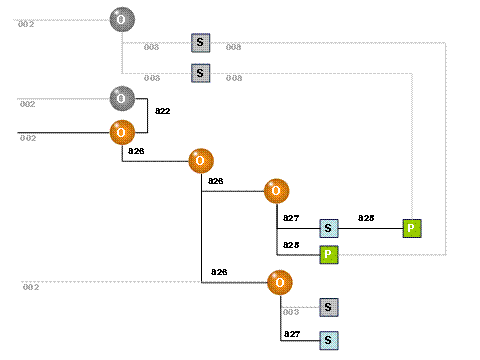
Exercise target relationships (graphical representation)
This example corresponds to the operational structure example.