
 Migration of Data with
LSMW
Migration of Data with
LSMW

Use
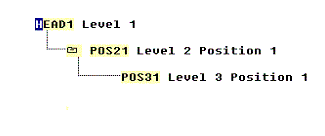
You can use the LSMW if the source structures are simple, like this for example:
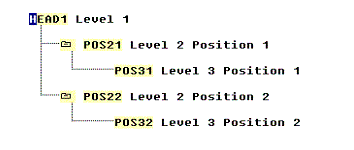
You can also use the LSMW if the legacy system has complex structures, like:
Prerequisites
A comparison of functions between the legacy system and the SAP system must have been carried out. The data to be migrated is determined from this comparison.
Process Flow

LSMW supports a step-by-step procedure. On the List of steps screen, the next step is automatically displayed for each step.
The following basic steps are included in the LSMW:
1. Maintaining Object Attributes Here, you define the project, subproject and the required (business) object. If a suitable SAP standard import program is not available, you can use the recording function to create a user-specific, new object.
2. Maintaining Source Structures
4. Maintaining Structure Relationships In these steps, you define the structures and fields of the project. These describe the transfer file and must have the same format in the export program. You then relate the structures and fields of the SAP system to those of the project.
5. Maintaining Field Mapping and Conversion Rules
6.
Maintaining Fixed
Values, Conversions and User-Defined Routines: Here, you define the
conversion rules for processing project data. The system generates the
conversion program from the structure and field relationships as well as the
conversion rules.
You then perform Migration Customizing. That is, you
assign values to the fixed values and translation values and specify the
definite variants for the conversion rules.
11. Converting Data
16. Start IDoc-Postprocessing: The converted data is transferred to the SAP system. The import technique or method has already been assigned to the object by selecting the object type in the first step.
Result
The data from the legacy system has been imported into the SAP database. Any subsequent processes result from the type of datasets migrated.
Additional Information
For more details about migrating data with the LSMW, see:
Definition of the Source Structures and Source Fields
Special Case: Migration of Long Texts