 Classic Framework Page
Classic Framework Page
The Classic Framework Page is the default framework page supplied with SAP NetWeaver Portal, which provides the navigational and structural components required to navigate and operate the portal. You can modify the Classic Framework Page or create your own framework pages to meet the requirements of your organization.
 Note
Note
In previous releases, the Classic Framework Page object was called the Default Framework Page.
Location in Portal Catalog:  Portal Content
  Portal Users Standard Portal Users Classic Framework Page
  (pcd:portal_content/every_user/general/frameworkpage)
 Caution
Do not modify the delta link source object of the above-mentioned framework page, which is located in a subfolder under the Content Provided by SAP folder.
For more information about the intended runtime use of the user interface components in the default portal desktop, see Portal Interface.
Headerless Default Framework Page
The Headerless Default Framework page supplied with the portal supports the headerless navigation mode (see Headerless Navigation).
For more information about navigation, see Navigation.
Integration
The Classic Framework Page supplied with SAP NetWeaver Portal is a single portal page containing default iViews and pages. These components are positioned in the framework page using default page layouts also supplied by SAP.
Pages and iViews in the Classic Framework Page
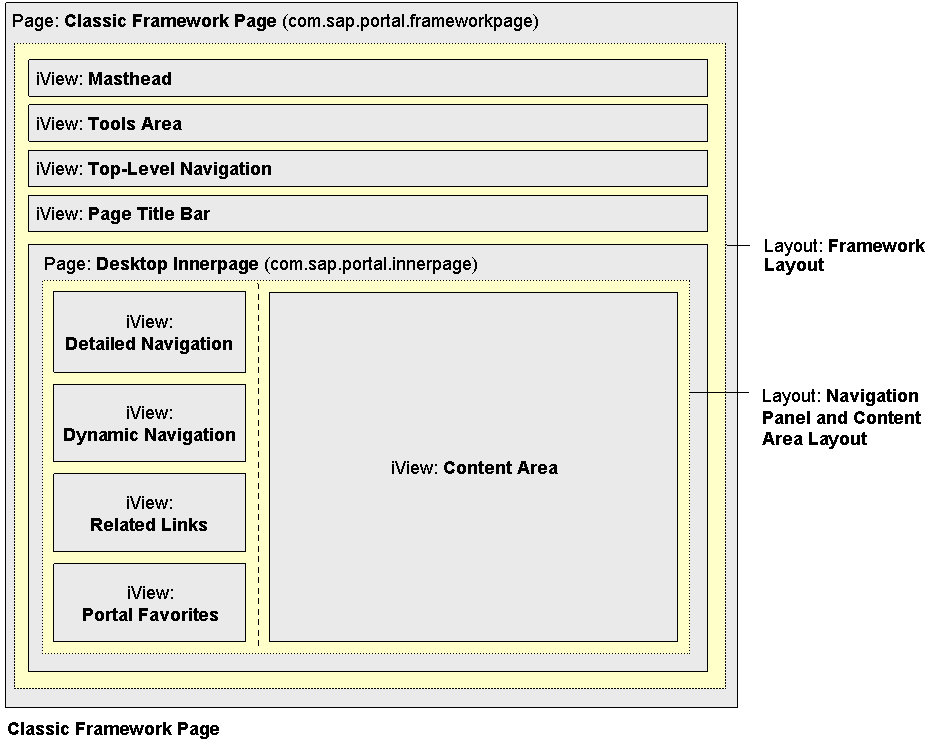
The Classic Framework Page is a portal page (com.sap.portal.frameworkpage) that contains the following iViews and pages:
Page: Headerless Framework Page (see Headerless Framework Pages).
Page Headerless Framework Page (Embedded) (see Headerless Framework Pages).
NoteIn the page editor, the Visible checkbox for the headerless framework pages within the Classic Framework Page is disabled.
End of the note.iView: Masthead iView
NoteAn administrator can show or hide the links in the Masthead iView at runtime by setting the Show Link in Masthead: <Link Name> properties in the iView using the Property Editor.
If you have configured your portal to accept anonymous users, you can add the language personalization dropdown list to the masthead, by changing the property Show Dropdown List in Masthead: Language Personalization for Anonymous Users in the Masthead iView to Yes. At runtime, anonymous users can change the portal language. If the anonymous user logs in as an authenticated user, the dropdown list disappears from the masthead, and the portal appears in the language defined for that user.
End of the note.iView: Tool Area
NoteThis iView is assigned to the Classic Framework Page, but is by default in a hidden state. To display it, change the property of this iView by editing it in the Classic Framework Page object (see Editing Content and Layout).
For information about integrating SAP NetWeaver Enterprise Search into the portal, read SAP Note 1337866.
End of the note.iView: Top-Level Navigation (see Top-Level Navigation)
iView: Page Title Bar (see Page Title Bar Navigation)
Page: Desktop Innerpage (com.sap.portal.innerpage)
This page contains the following iViews that comprise the navigation panel (see Navigation iViews) and the content area:
iView: Detailed Navigation (com.sap.portal.detailedNavigationTree) (see Detailed Navigation)
iView: Dynamic Navigation (see Dynamic Navigation)
iView: Drag&Relate Targets (see Drag&Relate Targets)
iView: Related Links (see Related Links)
iView: Portal Favorites (see Portal Favorites iView)
NoteThe Portal Favorites iView is available only after you have installed Knowledge Management.
End of the note.iView: Content Area
iView: Collaboration Detailed Navigation (com.sap.netweaver.coll.CollaborationDetailedNavigation)
When Collaboration is installed, an additional Detailed Navigation iView is added to the framework page that enables the integration of rooms in the portal.
The following figure illustrates the relative positioning of the components in the Classic Framework Page.
Layouts in the Classic Framework Page
The pages and iViews in the Classic Framework Page are spatially positioned through the use of two default page layouts:
Page Layout |
Assigned to Page |
Description |
|---|---|---|
Framework Page Layout (pcd:portal_content/com.sap.pct/admin.templates/layouts/com.sap.portal.layoutPortal1_Framework) |
Classic Framework Page |
Layout is a single full-width column |
Navigation Panel and Content Area Layout (pcd:portal_content/com.sap.pct/admin.templates/layouts/com.sap.portal.layoutPortal1_WAandNavPanel) |
Desktop Innerpage |
Layout is a two-column layout:
|