 Performance Measurement with KPIs
Purpose
The SAP APO key performance indicators (KPIs) express abstract supply chain objectives in financial or physical units for comparative purposes. Data pertaining to the various planning and execution processes such as demand planning or production scheduling is collected, measured, and transformed into physical or financial information that can be used to compare results and thus measure performance. The data is stored in the SAP Business Information Warehouse (SAP BW). SAP APO KPIs include some SCOR metrics and some that have been developed by SAP. KPI queries pull actual and historical performance data from the SAP BW for viewing in the Cockpit.
SAP APO KPIs are general purpose measurements that can be used as a framework for gauging performance effectively. They provide the necessary structure and set the direction for improvement. You can access the following types of KPIs:
Quality/service
Production control
Supply chain flexibility
Inventory control
Supplier performance
Human resources
Prerequisites
Connect to SAP BW 1.2B or higher (APO Customizing)
Define RFC destination (APO Customizing)
Maintain context menu profile (APO Customizing)
Install SAP BW front end
Fulfill SAP BW prerequisites for SAP R/3 data extractors
Install corresponding SAP R/3 modules (for example, HR must be installed for KPIs)
KPI queries are addressed by their workbook IDs. Any changes in queries must also be changed and saved in the same workbook
In the case of some KPIs, for example, the Inventory Days of Supply KPI, material types are defined as filter values. Changes must also be made and saved in the same workbook
Name SAP APO objects correctly (See Supply Chain Performance Measurement )
Process Flow
The performance measurement process is an ongoing one in which performance results are continuously compared and analyzed in order to determine whether your business is on or off target in meeting its goals. General performance measurement consists of the following procedures for each performance cycle. Cycles include procurement, manufacturing, and distribution.
Define a strategic supply chain vision
Define executive level measures for each objective
Establish managerial level objectives that align with executive ones
Establish targets for defined metrics through benchmarking
Measuring supply chain performance in APO can be achieved by following the cycle illustrated below:
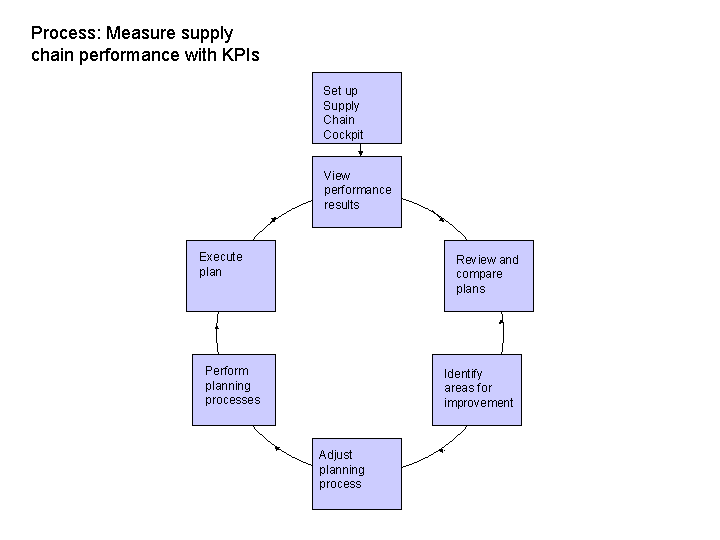
View current performance results by launching KPI queries from the SCC. KPI queries pull actual and historical performance data from the SAP Business Information Warehouse (SAP BW) for viewing in the Cockpit.
Review the data and compare it to your current plan.
Identify those areas in your performance cycles that need improvement and set targets for the upcoming round. Performance cycles include procurement, manufacturing, and distribution.
Adjust the planning process wherever necessary.
Perform planning process in planning system (SAP APO.)
Execute plan in execution system (SAP R/3 for instance).
View performance results (step 2).
Start the cycle again. Revisit on a routine basis
Result
By following this cycle you will be able to maintain a basic perspective of the dynamics of your organization and ensure your supply chain operations are working effectively. Remember that results must be viewed in relationship to each other. An improvement in one area may mean a lapse in another. For example, a decrease in production costs might inadvertently cause decrease in customer service, and thus would not be an improvement.
The use of metrics to measure performance is a complex business process that requires careful planning, analysis and a thorough knowledge of the supply chain. For more information on measuring supply chain performance, see the following topics:
Supply Chain Performance Measurement
Maintaining Context Menus (for viewing KPIs)
Key Figures in Demand Planning
For more information about SAP BW, see the SAP BW application help (20A)