 The SCOR Model
APO KPIs were developed according to the Supply Chain Operational Reference (SCOR) model, the standard reference process model developed by the Supply Chain Council (SCC) that has become the cross-industry standard for supply chain management.
The SCOR model depicts the basic supply chain, ranging from supplier's supplier to customer's customer, as a series of linked source -> make -> deliver execution processes managed by a series of planning processes.
The SCOR Model's Supply Chain
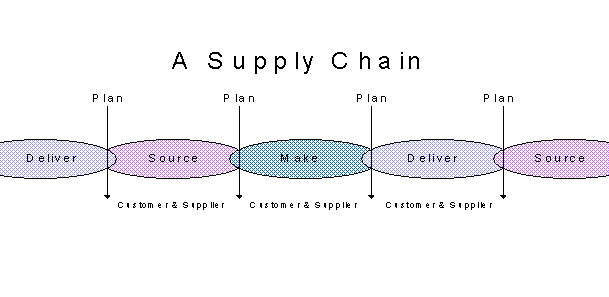
1998 Supply Chain Council
The SCOR model describes:
Standard management processes
Relationships between standard processes
Standard metrics to measure process performance
Management practices that produce best-in-class performance
Performance and diagnostic metrics together drive performance improvement. To evaluate supply chain performance, the SCOR model advocates a set of measurements comprising a combination of the following metrics:
Cycle time (production cycle and cash-to-cash cycle)
Cost (cost per shipment and cost per warehouse pick)
Service and quality (on-time shipments, defective products)
Asset (inventories)
Example of SCOR Metrics
The following table defines the top level SCOR processes and supplies the corresponding metrics used to measure performance in each area.
Level 1 SCOR Management Processes and Equivalent Metrics
SCOR Process |
Definition |
Functions |
Metrics (KPIs) |
Plan |
Processes that balance aggregate demand and supply to develop a course of action which best meets established business rules |
Demand/supply planning: Assess supply (categorization) Prioritize demand Plan inventory, distribution, production, material and capacity for all products and channels Manage planning infrastructure: Decide to make or buy Configure supply chain Plan long-term capacity and resources Phase products in/out Manage product line |
Demand and shipment forecast accuracy Adherence to plans Inventory turnover Planning cycle time |
Source |
Processes that procure goods and services to meet planned or actual demand |
Material acquisition: Obtain, receive inspect, hold, issue material Manage sourcing infrastructure: Manage vendor contracts, payments, certification and feedback Control sourcing quality Engineer components |
Vendor lead times Materials quality Materials inventories |
Make |
Processes that transform goods to a finished state to meet planned or actual demand |
Production Execution: Request/receive material Manufacture/test product Package/release product Manage make infrastructure: Manage facilities/equipment Track production status Control production quality Schedule operations Plan short-term capacity |
Production costs Product quality Changeover items Capacity utilization |
Deliver |
Processes that provide finished goods and services to meet planned or actual demand |
Order management Warehouse management Transportation management Distribution management |
On-time shipment On-time delivery Order fulfillment time Returns |
Benchmarking Techniques
Performance targets are set using one of the following methods, or a combination:
Historical benchmarking
is the most common and easiest method to implement since the targets are based on historical baseline levels. Baseline measures attempt to establish the current performance level ofa company, product, process, and so on, and should be established before improvement activities are initiated. For example, a company that currently has an order fill rate of 90% might set its performance target at 95%.Internal benchmarking
is the most popular approach. In this method, comparable departments, products, facilities are measured within a company, with a separate set of metrics being used for warehousing, manufacturing, customer service, and so on. The best-of-class is determined in each area and their metrics are used as a basis for establishing performance targets for the others.External benchmarking
is the most difficult method since it involves collecting performance data from other companies. This method is usually accomplished with external professional help.Theoretical target-setting
involves a company-wide analysis to determine how supply chain performance could theoretically be improved. The performance targets are based on estimates generated during the analysis. This method is far from easy to perform because only a very thorough analysis can determine how a decision will impact various aspects of the supply chain. However, this method is the surest way of developing a balanced set of metrics.