 BCS Availability Control
Use
You can use availability control ( AVC ) to monitor the availability of funds in the Budget Control System ( BCS ) of Funds Management (FM).
Availability control and BCS Budgeting are flexible tools that you can use to check consumable budget (budget or releases) against consumed amounts (commitment or actual postings) within a budget process. If budget consumption reaches one of the tolerance limits specified in Customizing, this can trigger system activities, for example, additional postings are prevented.
Overview of Availability Control
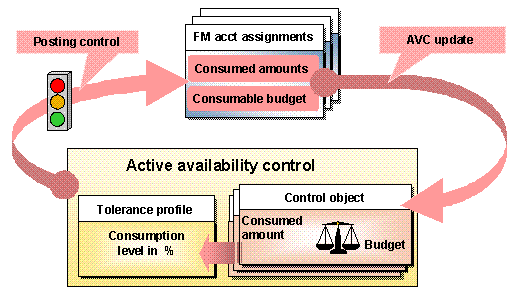
Using BCS availability control, you can:
Define the budget values or relases to be used to cover budget consumption
Set activity-specific tolerance limits
Define availability control objects, for which a check can be carried out of the updated and summarized budget, commitment and actual postings in Funds Management.
Carry out multi-level activation of availability control procedures
Use of a number of availability controls implemented in parallel
Implementation Considerations
AVCis an integral component ofBCS. To use it, you must carry out the Customizing activities under

Funds Management Government

Budget Control System
Availability Control.

Availability control is designed so that you can use it for other components independently of BCS budgeting, for example, in
Grants Management
.
Integration
Availability control checks the FM posting procedures and the posting data of the integrated components ( FI , CO , MM and so on) updated in FM.
For further information on the components that can be integrated with FM, see Recording Actual and Commitment Data .
Features
Availability Control Ledger (AVC Ledger)
In the availability control ledgers, the account assignment-related updating and summarization of the complete consumable budget are checked against the consumed amounts. This is carried out at the control object level.
For more information, see
Availability Control Ledger
.
AVC Filter Settings
If you work with releases or with different budget types in your organization, you can define which budget entered in the FM account assignments (or budget addresses) is made available as consumable budget in the control objects. You can also specify which commitment and actual postings update the availability control ledgers as consumed amounts. Fo r more information, see Availability Control Filter Settings .
Tolerance Profiles
All posting procedures updated and checked in the availability control ledger are classified according to an activity group . Activity groups subdivide postings according to specific posting procedures. This is specified in Customizing, where you can define activity groups and their assignment to posting transactions. You can combine different tolerance limits per activity group into a single tolerance profile. For more information, see Tolerance Profiles .
Availability Control Objects
The check of the posting data updated in AVC and the definition of the consumable budget takes place at the level of the availability control objects. You define the summarization of FM posting data and of budget data at the level of the AVC control objects in a derivation strategy. For more information, see Availability Control Object .
Activation Status of Availability Control
You can implement availability control at different activation levels perAVCledger. You can set the update of posting data in theAVCledger to
without
, with
normal
, or with
strict
availability control. You can find more information in Funds Management (FM) Customizing under
Budget Control System (BCS)
Availability Control
Define Activation of Availability Control.
Availability Control for Automatic Cover Eligibility Rules
You can use BCS cover eligibility to define automatic cover eligibility rules, which can subsequently also be used in BCS availability control. For more information, see Availability Control for Automatic CE Rules .
Restrictions
You cannot use BCS availability control as a replacement for the availability control in Former Budgeting. If you use Former Budgeting, not BCS , for budgeting in FM, you must also implement availability control for Former Budgeting.