 Cover Eligibility
Purpose
Public administrations must always attempt to achieve a working compromise between the necessary level of detail forbudgetingand further possible levels of detail for posting. However, in some cases it is not practical to shift budgets from one budget address (budgeting account assignment) to another. This could be the case, for example, if a certain distribution pattern of expenditures was not originally planned. Nor is it acceptable to intentionally change posting addresses, just because the budget distribution does not follow a certain expenditure pattern.
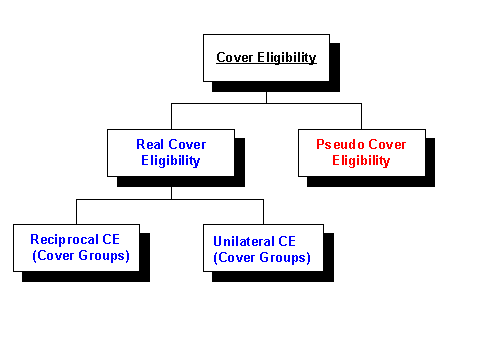
For this reason, the Budget Control System contains functionality that enables you to define the cover eligibility for your FM budget and posting addresses, so that additional budget can be made available if you require more funds on the expenditure side than originally planned in your budget.These additional expenditures are then ”covered” by other expenditures (or by revenues in the case of pseudo-cover eligibility) in other areas of a public organization.
This coverage can be unilateral (only sending or only receiving budget) or reciprocal (both sending and receiving), by means of user-defined
cover groups linking budget addresses.Before you can create such cover groups, or
http://aiokeh.wdf.sap.corp:50000/SAPIKS2/contentShow.sap?_CLASS=IWB_GLOS&TMP_IWB_TASK=PREVIEW&_LOIO=24F72230169002429BCA6B1A3E56BC2A&_SLOIO=AB17F53B9F150248E10000000A11402F&RELEASE=6955&LANGUAGE=EN&_SEQNUM=82&_SCLASS=IWB_STRUCTcover eligibility rules (CE rules), you must first customize cover eligibility in your system.
By specifying whether an account assignment (budget address) sends or receives budget, and whether this occurs manually or automatically , you create cover groups or CE rules that clearly define which account assignments can participate in cover eligibility and in which way.
Implementation Considerations
Before you begin using cover eligibility, there are several activities in the Implementation Guide that you must maintain.
For this go to the Implementation Guide, Public Sector Management
→
Funds Management Government
→
Budget Control System (BCS)
→
Budgeting
→
Control Budgeting Flow
→
Cover Eligibility.
Cover eligibility must be activated for your FM area.
If you want to work with budget memos for cover eligibility rules, you must activate their use.
Internal or external number range intervals must be maintained for cover groups. These number range intervals are used for the generation or manual creation of cover eligibility rules.
If you want to use pseudo-cover eligibility, you must first activate RIB call procedure.
If you want to generate cover groups, you must maintain a derivation strategy in Customizing to determine which budget addresses should be involved in a cover group (or CE rule).
Integration
Cover eligibility is an integral part of the Budget Control System (BCS).
Features
You can generate cover eligibility rules automatically via the derivation strategy for the generation of cover groups. You can also manually create, change and display individual cover groups.For more information, see Cover Eligibility Rules .
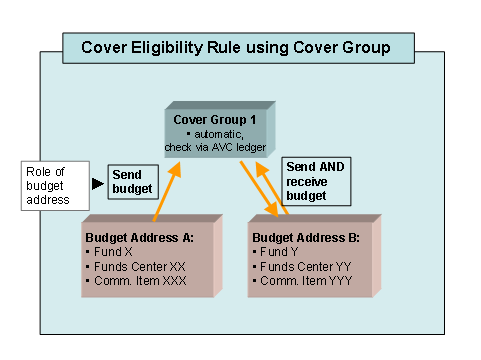
The following graphic illustrates one possible way to set up a cover eligibility rule.
Constraints
Pseudo-cover eligibility(see above figure), which would enable an organization to use
additional unplanned revenues
for expenditures in an automatic manner via availability control checking, is available under the term RIB call procedure.
Example
Several public administrations in one organization decide to join and share expenditure budgets automatically via AVC checking. For this, multiple individual budgets are to be combined in an automatic cover group containing all of the respective budget addresses, with the following results:
For each cover group, the head organization defines the participating budget addresses and the relationships of the addresses (sender, receiver of budget, or both) within the group to each other.
The system checks postings to any of the participating expenditure addresses for availability.It not only checks against the individual budget of the relevant budget address, but also against the grouped budget of the automatic cover group to which this individual budget address belongs. For more information, see Availability Control for Automatic CE Rules .