 Availability Control Ledger
Definition
The availability control ledger (AVC ledger) is managed in a separate database area of the component
Special Ledger
(FI-SL). Here, BCS budget data and commitment/actual data of Funds Management (FM) is updated to availability control objects (
control objects), which are derived from the specific account assignment elements (budget and posting addresses) of the budget or commitment/actual records.
Use
Availability control carries out the update and summarization of all Funds Management postings (commitment/actual data or budget data) to be checked in an AVC ledger. In the standard system, two ledgers are supported: ledger 9H for the payment budget and ledger 9I for the commitment budget. You can also create additional user-specific ledgers.
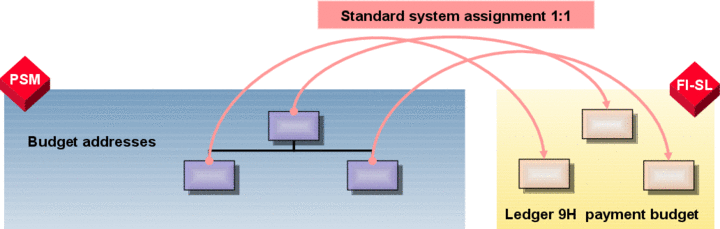
Per default, that is, without a derivation strategy or with an empty derivation strategy, SAP supports a 1:1 derivation of Funds Management budget addresses to the corresponding control objects of the AVC ledger (example: ledger 9H).
Availability Control Objects without a Derivation Strategy
 Note
Note
The update of “budget-consuming” posting data (commitment/actual postings) in the control objects of the AVC ledger takes place in two successive derivation steps. You start with the derivation of the budget address from the posting address of the commitment/actual posting item, using the derivation strategy defined in the BCS Budget Structure . Then the derivation of the control object is applied to the budget address, which is assigned to the posting address from the budget structure.
If you want to update budget or commitment/actual data in the AVC ledger according to your own requirements, you can do this using a derivation strategy for availability control objects.
The example below shows how the data from three budget addresses is summarized in one control object. Although this example shows the derivation for budget addresses contained in one master data hierarchy, this is not relevant for the definition of a derivation strategy for availability control objects. In this way, you can also have data from hierarchy-independent budget addresses summarized in one control object.
Summarization Using a Derivation Strategy

You must assign a default tolerance profile, as well as define the tolerance limits in this profile, for each AVC ledger you want to use. You do this in your FM area from a selected fiscal year onward. You can also use different tolerance profiles for particular control objects. You then define and assign a derivation strategy for tolerance profiles, which overrides this default tolerance profile. For these particular cases, the tolerance settings of another tolerance profile are then used for online AVC checks, instead of the settings from the default tolerance profile.
User-Specific Availability Control Ledger
However, if the use of a single AVC ledger per budget category does not meet the requirements of your organization, you can define additional user-specific AVC ledgers. In this case, you work with a number of parallel AVC ledgers in one FM area/fiscal year. . In each ledger, the budgetand commitment/actual data from Funds Management can be summarized according to ledger-specific derivation strategies for control objects and for tolerance profiles. Each document to be posted has to pass the AVC checks of all parallel AVC ledgers.
Note
Note that using parallel activated availability control checks can have a negative effect on system performance. SAP recommends that you do not use more than three or four AVC ledgers simultaneously.
You define user-specific ledgers in the Customizing of Funds Management, under

Budget Control System (BCS)

BCS Availability Control
Settings for Availability Control Ledger
Maintain Customer-Specific Ledger for Availability Check
 .
.
See also: