
 Basics

Design, Configuration, and Runtime
The implementation of a collaborative process is split into three phases:
- During the design phase, you document the entire collaborative process and determine which interfaces are required. You can either define new system-independent interfaces to implement at a later point in time (outside-in development) or work with functions that already exist in the systems (inside-out development). In this phase you design the logical collaborative process by describing in a specific role the message exchange between the application components. This description is still not specific to any particular installed system.
More information: Design Time
- During the configuration phase, you configure your collaborative process for a specific system landscape. For example, you define conditions for the message flow and select design objects that meet your requirements.
More information: Configuration Time
● The configuration data is evaluated at runtime and controls communication. You can monitor the message flow by using a central monitoring.
This three-stage process is reflected in the architecture:
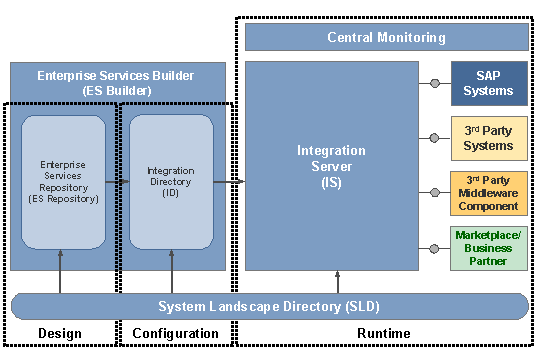
● Design time and configuration time each have a central data storage point providing an overview of all data that is relevant to the cross-component process: the Enterprise Services Repository (ES Repository) and the Integration Directory respectively. You then process this data with either the Enterprise Services Builder (ES Builder) or the Integration Builder. The content of the ES Repository and Integration Directory is known as collaboration knowledge.
The Integration Server is the central ‘distribution engine’ for messages at runtime. All systems that use the Integration Server to communicate with each other use this server to exchange messages. These systems are referred to as business systems at a logical level; within a specific system landscape they are called technical systems or communication parties. Using the configuration data from the Integration Directory, the Integration Server decides to which receiver or receivers it must send the message and whether a mapping needs to be executed beforehand.
The Connectivity section describes the options available for connecting systems to the Integration Server.
Integration Server and System Landscape Directory
In the Integration Server, you save design-time objects in the ES Repository and configuration-time objects in the Integration Directory. The System Landscape Directory (SLD) is an SAP product that enables you to describe products, software components, logical systems, and technical systems. The Integration Server accesses this information at design time, configuration time, and runtime.
Relationship Between SLD and ES Repository/Integration Directory
Phase |
Objects Used in System Landscape Directory |
Design
Time |
|
Configuration
Time |
Technical systems (for example, an SAP system), in other words components installed in a system landscape |
The differentiation between objects from a logical collaborative process and the installed system landscape is also made in the SLD. However, this distinction is not reflected in the product names (System Landscape Directory).
More information:
 System
Landscape Directory in Process Integration
System
Landscape Directory in Process Integration