Calculating and Deleting Subtotals
Normally, totals can only be calculated using key figures, while subtotals can only be calculated using characteristics. You must have created the total for at least one column. The icon and the menu entries for calculating subtotals will not become active until you have calculated a total.
The following example explains the concept of totals and subtotals:

First of all, a total is calculated for the Occupied column.
A subtotal is then calculated for flight number No column. The total is broken down into multiple subtotals. A subtotal is a total numer of occupied seats for all rows that have the same subtotal criterion value (in this case, flight number No.).
In other words: The rows between two subtotals have the same value of the subtotal criterion - the identical flight number (No.). The total number of occupied seats (Occupied) of a flight number represents the subtotal.
Choose
 .
.
Alternatively:
Right click on one of the column headers you selected.
Choose Subtotals
If you choose the subtotals function without having selected a column, in the Define Sorting/Subtotals dialog box you are requested to select the columns that you want to calculate subtotals for. To do this, you proceed as follows:
Select the relevant entries in Available Columns.
Choose
 to add the selected entries to the Sort Criteria/Subtotals.
Alternatively:
Select the relevant entries in Available Columns.
Click on the selected entry or entries again, this time without letting go of the mouse button. The cursor now appears with a small rectangle.
Drag the entries to the Sort Criteria/Subtotals column, and drop them there.
To Search for Terms, choose  .
.
To define a subtotal for a column or columns, select the checkbox under the subttotal icon. A checkmark is set.
To change the sort type and order, see section Sorting in Ascending or Descending Order.
To apply the settings, choose
 .
.
In the example above, a total was calculated for the Occupancy column, and a subtotal for the Airline and Flight No. columns.
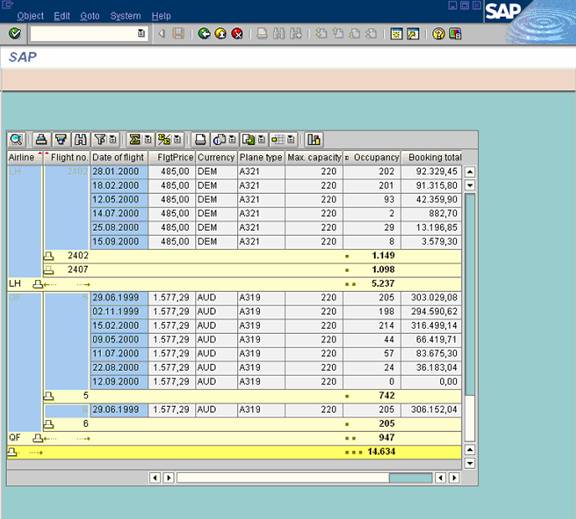
IOn this screen you see the two subtotal levels as well as the non-total rows. The first subtotal level totals the occupied seats (Occupancy) for the rows with the same flight number (Flight no.) - the first subtotal criterion. One small square next to the subtotals indicates this first level of the subtotal calcuation.
The second subtotal calcuation level adds the subtotals of the first level with the same Airline - the second subtotal criterion. Two small squares next to the subtotals indicate this second of the subtotal calcuation. To help with orientation, small arrows are used that link the subtotal with the associated subtotal criterion.
Three small squares indicate the third level - the totals calculation. This indicates that the total calculates the subtotals of the top level.
You have two options to hide entries below a specific total or subtotal and to display only the subtotals:
Click on the squares of the relevant subtotal row.
Click on the
 icon in the relevant subtotal row.
The entries below this total or subtotal are hidden. The  icon displayed in the subtotal row indicates that entries underneath a total or subtotal have been hidden.
To hide all entries and subtotals for a total or subtotal level, see section Defining Drilldown Summation Level.
To delete a subtotal, choose , without selected a column. If you were to select a column, a new subtotal would be defined for this column.
The Define Sorting/Subtotals dialog box appears.
To delete the subtotal, deselect the relevant checkbox underneath the subtotals icon.
To change or delete a sorting, see section Sorting in Ascending or Descending Order.
To apply your settings, choose .
In addition to the procedure described above, in lists in Fullscreen View you can calculate subtotals from the menu path.
Choose
 Edit
Edit  Subtotals
  .
.
To delete a subtotal, choose
Edit Subtotals , without selecting a column.