
 Top-Down and Bottom-Up Sales
Planning
Top-Down and Bottom-Up Sales
Planning

Roles in the Planning Process
The following roles are defined for this planning process:
· Marketing Manager (MM)
· Sales Manager (SM)
· Account Manager (Head Office, Region)
The following diagram shows how these roles are assigned to the different levels in the customer hierarchy.
Roles and customer hierarchy

Planning Folders and a Variable for Defining Worklists are available for the above roles.
Annual planning
You execute annual planning once a year prior to the plan year. The starting point for annual planning is the previous year’s actual values, the current rolling plan (current forecast), and the forecast for the plan year.
Marketing managers, sales managers, and account managers do the planning for the customer hierarchy levels to which they are assigned. This planning is based on:
· Net revenue (see also Planning of Net Revenue and Billing Quantity)
· Billing Quantity (see also Planning of Net Revenue and Billing Quantity)
· Contribution Margins (see also Contribution Margin Planning)
Annual Planning Process
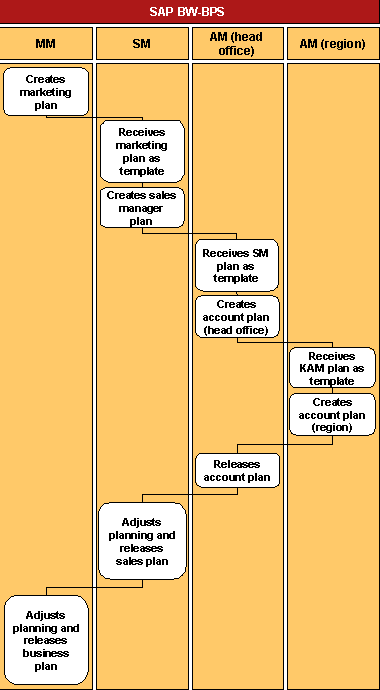
1. The Marketing Manager (MM) creates the marketing plan.
2. The Sales Manager (SM) receives a template of the marketing plan.
3. The Sales Manager creates the SM plan.
The Sales Manager carries out planning for all customers and assigns the values top-down to the account groups.
4. The Account Manager (AM) receives a template of the sales plan.
5. The Account Manager creates the plan for the head office of the account.
The Account Manager does the planning for an account group, and assigns the values top-down to the accounts and sub-accounts in the group.
6. The Account Manager creates the regional account plan.
The Account Manager assigns the planning top-down to channels and regions in the account. The Account Manager also carries out a bottom-up planning process against the planning at account head office level.
7. The Account Manager releases the account plan for the region level and the head office level as soon as the planning within an account is complete.
8. The Sales Manager compares the aggregated account plans with his own planning and releases the sales plan.
9. The Marketing Manager compares the company-wide plans (sales plan, marketing plan, etc.) and releases them as the business plan.

These
process steps are usually executed several times before the business plan is
created. It is crucial that the managers coordinate their activities and
compare plan versions. To aid
comparison, they can use the queries
 Plan-Plan Comparison
Net Revenue,
Plan-Plan Comparison
Conditions, and
Plan-Plan Comparison
Conditions (%).
Plan-Plan Comparison
Net Revenue,
Plan-Plan Comparison
Conditions, and
Plan-Plan Comparison
Conditions (%).
Rolling Planning
You can execute rolling planning for the current year several times in the course of a year. The starting point for rolling planning is the business plan, or the current forecast and the forecast for the plan year. The rolling planning process is largely similar to annual planning. The only difference is that the last release of the company-wide is not the business plan, but the current forecast. This ensures that the business plan can always be used for the whole year.
Top-Down Distribution
The top-down distribution is made according to the following rules:
· The distribution is always a "distribution without remainder". This means that a plan value for a hierarchy node is distributed 100% to all nodes directly underneath if there is reference data stored for these nodes.
· The distribution is made in proportion to the plan values of the target nodes.
This must be taken into account especially when a new planning process begins with the marketing manager: The actual data from the previous year is taken as the plan data in this case. The distribution can then be made on the basis of the plan values.
This procedure was chosen for two reasons:
¡ Changes can be taken into account in the planning process. New product launches for which there is no direct history can be considered in the planning process.
¡ Not every planning layout provides historical data as reference data for distribution. The distribution is generally made according to planned values. This avoids the need to have two planning steps - distribution by historical values in one step, and distribution by planned values in the next.
Planning Organization
A central element in the planning organization is the version (InfoObject: 0VERSION). The version is used to specify
· Whether the version is a work version or a released version of a plan
· Whether it is the business plan or the current forecast
· Which role is responsible for the plan (such as sales manager)
Any role can plan trade promotions. Trade promotions are allocated the version TPM.
The following diagram illustrates the version concept:
