 Cost Center Planning
Cost Center Planning
Purpose
The planning application "cost center planning" enables the planning of the necessary budget of cost centers in the organizational structure of your company. You identify and value the relevant
cost drivers, define manually entered prices (also called "political prices") for the internal activity allocation and enter primary and secondary costs. The following graphic gives an overview of the methods used in cost center planning: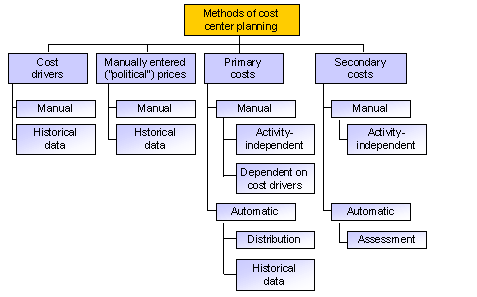
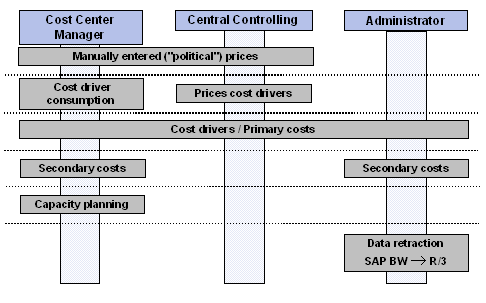
SEM-BPS supports cost center planning as an iterative process, in which the budget requirements of the cost center manager are balanced with the central figures of Controlling. The process control is realized with the
 Status and Tracking System, though the system automatically determines the persons who are involved in the planning process using the assigned cost center hierarchy. In addition to the cost center manager and controller roles, the application also plans for some central activities which are carried out by an administrator. The following graphic shows the distribution of tasks to the different roles:
Cost center planning in SEM-BPS is closely linked with the operational Cost Center Accounting in the SAP R/3 System (component CO-OM-CCA). The connection between the analytical and the operational system is established using a
retractor, which reads the budget planned in the SEM System from the corresponding InfoCube of the SAP Business Information Warehouse (SAP BW) and transfers it back into the data structures of the operational system. There the data is available for further processing.Entering plan data is made considerably easier by using
Characteristic Relationships, which are defined in the planning areas relevant for cost center planning. With the help of these relationships, the system can determine the respective currency or activity unit on the basis of the values entered by the cost center manager, for example, cost center or activity type and automatically assign it to the data record.
Two approaches are distinguished between in cost center planning: fixed and flexible budgeting. While the fixed budgeting dispenses with an allocation in proportional and fixed cost items, this allocation is intended for the flexible budgeting. Fixed budgeting is suitable because proportional costs are not reported separately, only for cost control in companies with low time fluctuations of the operating rate. However, flexible budgeting is also suitable for a cost control in an environment with great changes.
At present, cost center planning with SEM-BPS supports the approach of fixed budgeting.
Prerequisites
You have to activate the delivered planning application. For more information, see
Generating Sample Data.In order to use the retractor functions, you must enter in the parameter groups of retractor functions the RFC destination which refers to the operational R/3 System that you want to transfer plan data to. For more information, see
Cost Center Planning: Data Retraction.Process Flow
The general process flow of cost center planning covers the following steps: