 Processing RFQs and Quotations
Processing RFQs and Quotations
Purpose
The customer describes the most important requirements of the power plant in the RFQ. Since the probability of receiving an order is great, you decide to create a quotation.
The quotation contains the technical specifications in accordance with the customer’s wishes and details on prices and dates. For this, you must carry out internal planning for the activities, resources and costs known of at this time.
Quotations are collected from vendors for parts that have to be procured externally such as materials, accessories, tools or equipment. Furthermore, project-specific RFQs can be made to subcontractors in order to collect and compare dates and prices for services. This must be done so that the quotation price can be created in detail.
In practice, there are often negotiations with customers and vendors until a satisfactory compromise has been found for all parties.
In the planning phase particularly, knowledge about a specific project changes constantly. Quotation processing represents an iterative process: the individual steps can be carried out several times. However, management of project simulation and several quotations is necessary to keep the process clear and comprehensive and so that different scenarios can be compared to one another.
Process Flow
The following graphic clarifies the process:
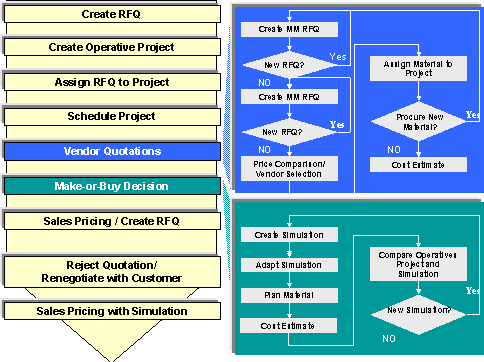
The process starts when a customer inquiry is entered. The customer is, for example, the Canadian corporate group North Energy Ltd / Calgary.
You decide to create a project structure for the power plant and assign the RFQ to the project account for the purposes of quotation creation (planning, scheduling and costing).
In order to be able to make a quotation, preliminary project planning must have taken place. For this reason, project structures (WBS, networks) are adapted to suit the current RFQ. WBS elements are deleted or created. Duration, work, sequence, components etc. are adapted in the networks.
The ideal case that standard structures can implemented unchanged is used in the example process, so the scenario mentioned above cannot be used.
In the next step, you schedule the project for the first time ( Scheduling a Project ) to determine whether the delivery date can be kept.
As well as calculating the cost of in-house services, you also have to collect prices for components to be procured externally in a request for quotation.
Using the Boiler component as an example, collect quotations from vendors and adapt your project planning accordingly.
You have to make a make or buy decision for the generator, for example, because it can either be manufactured in-house or procured externally. To do this, create a simulation (in-house production) that will then be compared to the operational project.
Due to cost issues, you decide to procure the generator externally.
You use sales pricing to create a resource-related quotation on the basis of detailed project planning. The quotation contains the technical specifications in accordance with the customer’s wishes and details on prices and dates.
The customer has special requests and requirements so the generator is manufactured in-house after all.
Using sales pricing, you create a new quotation based on the results of negotiations.
Result
Quotation processing ends when the customer places an order (letter of indent).