
Application Summary
| Payment Application Name | GK/Retail OmniPOS | Payment Application Version | 5.27.0 |
|---|---|---|---|
| Application Description | The GK/Retail Point-of-Sale solution comprises front-end applications for all manner of checkout systems – from classic touch, display or two-digit code systems through to mobile POS options for tablets, smartphones, and self-checkouts. All systems connect to third-party EFT systems exclusively for the transfer of the amounts of purchased items. The GK/Retail solution does not store any data of electronic funds by any means. The EFT systems connect directly to the POS via ports (COM, USB) or TCP/IP. Cardholder data is processed only in truncated format. | ||
| Typical Role of Application | In general, the GK/Retail system is used in a retail environment such as in food retailing, apparel, perfumery, and DIY stores as well in the sporting goods industry. In addition, GK/Retail solutions are found in telecommunication and stadium shops. It is possible to run supervised POS stations, unattended self-service systems, self scanning applications, or flexible mobile POS solutions. | ||
| Stored Cardholder Data | The following is a brief description of files and tables that store cardholder data: | ||
| File or Table Name | Description of Stored Cardholder Data | ||
| Cardholder data is not stored on GK systems. | Not applicable | ||
| Individual access to cardholder data is logged as follows:
Not applicable |
|||
| Components of the Payment Application | The following are the application-vendor-developed components which comprise the payment application: | ||
|
|||
| Operating System(s) Supported | The following are operating systems supported or required by the payment application: | ||
Latest Supported Versions (see also Product Availability Matrix):
Systems must be able to run a Java Virtual Machine. |
|||
| Application Authentication | GK/Retail OmniPOS does not require sensitive authentication data. Such data are not saved or processed. Authentication credentials used by the payment application are provided by the underlying operating system or other authentication software. |
||
| Application Encryption | Encryption used by the payment application is provided by the underlying operating system or other authentication software. Standard encryption libraries (Bouncy Castle, BCRYPT) are embedded into the product. BCRYPT 448 Bit Hash, SHA-256, SHA-384, SHA-512 |
||
| Payment Processing Connections: | 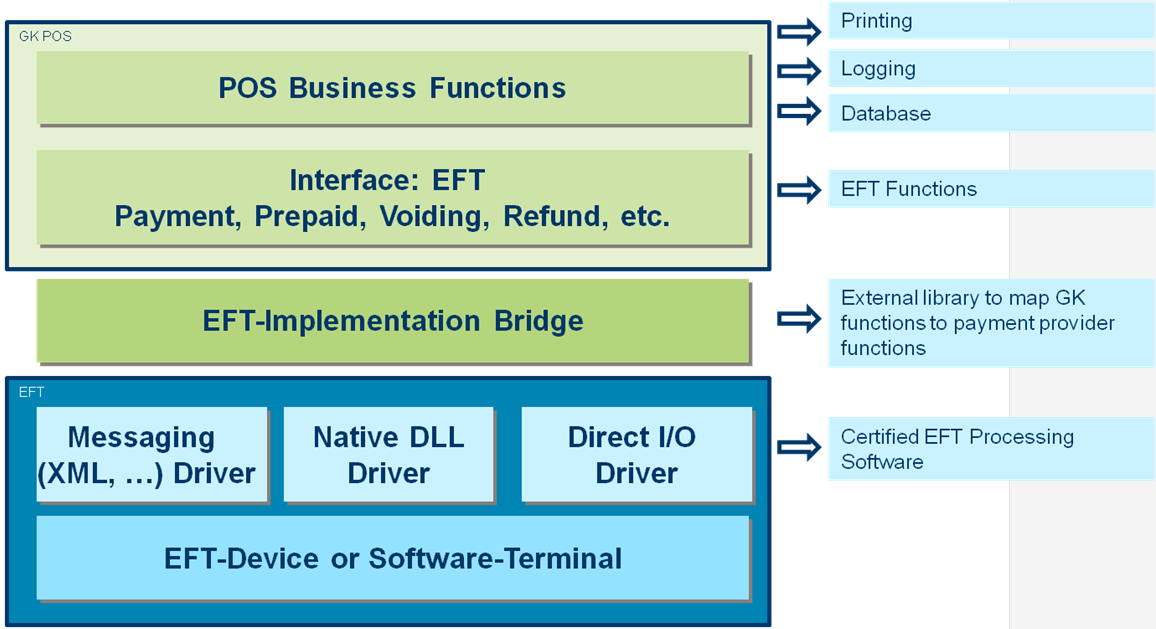
|
||
| Description of Listing Versioning Methodology | GK/Retail OmniPOS versioning has three levels, Product Version, Major, Minor: <Product>.<Major>.<Minor>
GK/Retail OmniPOS versioning can have the following numbering scheme: <1-3 digits>.<1-3 digits>.<1-3 digits> e.g. 5.27.0
The impact on the SSS requirements (low impact change vs. high impact change) has to be analyzed per all versions in the "Critical Asset List". Based on the above versioning methodology, the application version listed with the PCI PA-DSS was: 5.0.x (2015), 5.4.x (2016), 5.5.x (2017/04), 5.6.x (2017/09), 5.7.x (2018/04), 5.9.x (2018/10), 5.11.X (2019/08), 5.15.X (2020/04), 5.19.X (2021/02). The application version 5.21.0 was validated with PCI SSS (2022/06) and conformity is attested yearly. Latest attestation of validation was done 2023/06. Latest PCI SSS was done for application version 5.27.0 in 2025/06. |
||