 Buffer Distribution
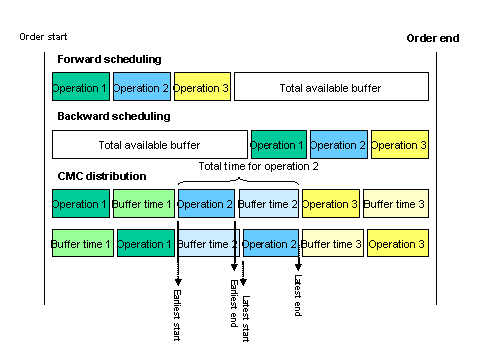
The CMC distributes and evaluates the total available buffer among all operations in an order when performing scheduling. The CMC reschedules orders forwards as in the standard system and then distributes the total available buffer among the operations in an order. The total available buffer is the time that an operation/order can be shifted into the future starting from its earliest date, without affecting the latest date(s) of its successor(s) or the latest finish date of the complete order.
Each operation in the order is assigned a time and date value for the earliest scheduled start and end, as well as latest scheduled start and end based on the standard duration of the operation and available buffer. If only one work center processes the order, it can use the total available buffer. However, problems may arise when more than one work center is involved in the MRO activities. Here, the first work center may use up the total available buffer without affecting the latest dates of its successor. However, the next work center is then under pressure to start work on the order immediately after receiving the spare part (that is, their earliest and latest start dates are equal, as are their earliest and latest end dates).
To avoid this problem, the CMC divides the total buffer for an order, and assigns a portion to each work center involved in the process. This means that each work center is only allowed to retain a part for a period that is equal to work time plus the assigned portion of available buffer. If the work center then exceeds this period, the system displays the operation with an alert setting , which is dependent on the values set in Customizing for order codes and priority rules.
The assigned buffer allows short term planning within each work center, and can be viewed as a type of work center ‘autonomy’ in the overall planning process. If the order has buffer, the system distributes it among the order operations. Each work center is responsible for planning their activities within these constraints.
 Caution
The CMC does not consider the actual scenario when distributing buffer. Instead it looks at the scenario as it should be. The CMC only updates or changes the buffer if you change the basic dates in the order header, or the duration of the operations in the order, or you add or delete operations in the order.
The CMC displays the buffer value for the consecutive order operations in a work center. It uses this value to calculate the earliest and latest end dates for each operation in an order.
Every time you start the CMC or click on the Refresh button in the application toolbar the system calculates and distributes the buffer (depending on the selected processing mode).
 Note
Note
To save performance, the system does not save or update the times and dates for each work center calculated by the CMC in each individual order. However, manual update is possible from within the CMC.
The buffer for open-loop orders may differ over time, which means that no work center is guaranteed the initial buffer that it was assigned when the order was scheduled by the CMC the first time. If the first work centers in the MRO chain postpone the start of their operations meaning that the ROC date keeps declining, the later work centers in the chain may have buffer problems. In the worst case, the order would not be completed on time.
To avoid such situations, the CMC uses a formula built on arithmetic progression to distribute the buffer among the work centers involved in order processing. In this way, if you have set the
Stretch factor
to zero in Customizing of
CMC order codes
the CMC can distribute the buffer proportionally among the order operations with the respective order code. If the
Stretch factor
is greater than zero, the CMC distributes the buffer progressively and reassigns buffer from earlier operation(s) to later operation(s) in the MRO process. This forces the first work center to start work immediately, thus leaving more buffer to the last work center in the chain, and allows orders to be completed on time.
Caution
It should be noted that distribution of the buffer does not take into account time constraints on a particular operation in orders.
Buffer distribution also ignores relationships within the order.
 Example
An order has two operations, each in a different work center, and it must be completed within one month. However, the earliest possible start date of the second operation is in three weeks. The CMC distributes the buffer as described above, ignoring this time constraint.
For information about how the CMC calculates the share of buffer for each operation, see Progressive Distribution of Buffer and Proportional Distribution of Buffer . For information about how the CMC calculates the buffer, see Calculation of Buffer .