 Posting Example for Cost of Sales Accounting: Repetitive Manufacturing
Posting Example for Cost of Sales Accounting: Repetitive Manufacturing
Purpose
This process is part of a sequence of processes that show cost of sales reporting for the profit and loss statement using the special purpose ledger. The processes for repetitive manufacturing and their effect on the profit and loss statement are demonstrated. The other processes deal with the following topics:
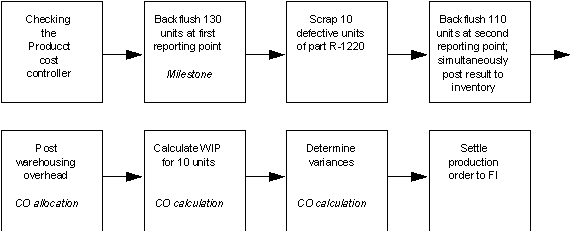
In this production process, you manufacture a product (a PC component) in repetitive manufacturing. First of all, you analyze the master data of the product cost controller. This forms the basis for updating the costs. You then produce the production line memory chips that you report at various reporting points. You analyze the costs on the product cost controller. Due to a production error, you have to scrap some of the components. The finished products are then transferred to stock. You calculate the overhead costs, the work in process (WIP), and the variances.
The following diagram reflects the procedures in this process:
Special Notes
-
Select a run schedule header with a different date.-
Create new materials.-
Execute this example in a client where you are the only active user.For more information about this process, see
 .
.
Process Flow
You can find the data for this process under
 .
. Displaying Material Master Data
Displaying Bills of Material
Displaying Routings
Displaying Product Cost Collectors
Preliminary Costing of Product Cost Collectors
Backflushing for the First Reporting Point
Displaying Goods Issue Documents
Creating the Profit and Loss Statement Using Cost of Sales Accounting (I)
Analyzing Costs for the Product Cost Collector
Entering Scrap for Reporting Point 2
Displaying Material Documents
Creating the Profit and Loss Statement Using Cost of Sales Accounting (II)
Backflushing for the Second Reporting Point
Displaying Material Documents (II)
Creating the Profit and Loss Statement Using Cost of Sales Accounting (III)
Calculating Overheads
Determining WIP
Determining Variances
Settling the Product Cost Controller
Creating the Profit and Loss Statement Using Cost of Sales Accounting (IV)
Displaying Material Master Data
Displaying Bills of Material
Displaying Routings
Displaying Product Cost Collectors
Preliminary Costing of Product Cost Collectors
Backflushing for the First Reporting Point
Displaying Goods Issue Documents
Creating the Profit and Loss Statement Using Cost of Sales Accounting (I)
Analyzing Costs for the Product Cost Collector
Entering Scrap for Reporting Point 2
Displaying Material Documents
Creating the Profit and Loss Statement Using Cost of Sales Accounting (II)
Backflushing for the Second Reporting Point
Displaying Material Documents (II)
Creating the Profit and Loss Statement Using Cost of Sales Accounting (III)
Calculating Overheads
Determining WIP
Determining Variances
Settling the Product Cost Controller
Creating the Profit and Loss Statement Using Cost of Sales Accounting (IV)