
 Settings for the Rules-Based Availability
Check
Settings for the Rules-Based Availability
Check

Use
The settings you make for the rules-based availability check are essentially divided into two areas:
Prerequisites
● You have set the indicator Rules-Based ATP Allowed under Global Available-to-Promise (Global ATP) → General Settings → Maintain Check Instructions in the Customizing of SAP APO.
● If the Online Transaction Processing System (OLTP system) is an ERP system, you have maintained a business transaction and assigned it to an order type. In the ERP System choose Customizing for Sales and Distribution via Basic Functions → Availability Check and Transfer of Requirements → Availability Check → Rules-Based Availability Check → Define Business Transaction and Assign Business Transaction to Sales Order Type.
Interaction of Condition Technique and Rules
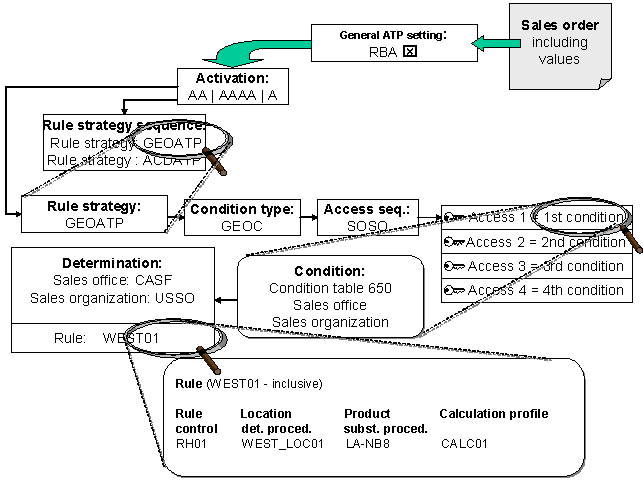
The rule strategy sequence groups rule strategies. The rule strategy refers to several condition types. One access sequence is assigned to each condition type. An access sequence contains a list of accesses, also called condition tables. Each condition table contains one or more fields.
In the rule determination, comparison values, which are used to determine a rule based on the condition type and condition, are saved for the fields affected by this process.
Process
...
1. You define different key combinations (fields that you have chosen) from the field catalog and assign them to database tables, so-called condition tables.
2. The rule strategy or the rule strategy sequence is used to find condition tables. A rule strategy can contain several condition types. In most cases, you should not use more than one condition type.
3. You assign an access sequence to each condition type. The access sequence specifies which condition tables are relevant for a specific condition type. An individual step within this access sequence corresponds to the access to a condition table. Based on the fields defined in the table (key combinations), the system can find the valid condition records.
4. When you create the rule determination, you save comparison values, which are used to determine a rule based on the condition type and condition, for the relevant fields.
5. The rule can contain several procedures: the product substitution procedure, location determination procedure - or alternatively, a location product substitution procedure, PPM substitution procedure, rule control and calculation profile.