 System Architecture and Offline Capabilities
Use
A prerequisite for flexible, mobile, and offline IT support for logistics and administrative processes when operations (and exercises) are performed is a distributed system architecture.
For this reason, in conjunction with the
SAP Mobile Defense & Security
component, the
Defense Forces & Public Security
component supports a multilevel system architecture, which is graphically represented below.
Prerequisites
In addition to the
Defense Forces & Public Security component, you have also implemented the
SAP Mobile Defense & Security
component, which is provided separately.
You are familiar with the set-up of SAP system landscapes.
Features
The system landscape supported by the
Defense Forces & Public Security
and
SAP Mobile Defense & Security
components consists of
production systems for your domestic base, operations, and exercises, as well as systems for the
administration and
quality assurance of the entire system landscape.
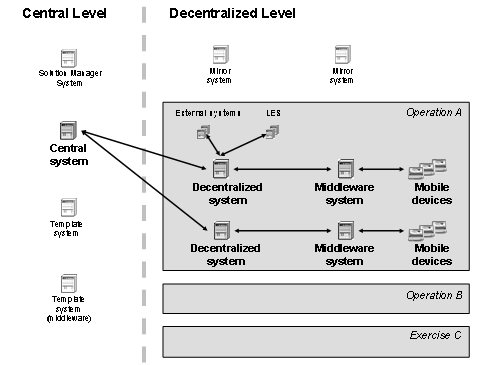
Production Systems (Simplified Presentation)
The figure shows an example of communication between production systems for one of three independent operation system landscapes. Alternatively, data can be synchronized between the systems via the SAP Exchange Infrastructure. For a relevant, detailed figure, see Synchronization Using XI System .
Logical System Levels
The system landscape supported by the
Defense Forces & Public Security
and
SAP Mobile Defense & Security
components is divided into two
logical system levels:
Central level
This level includes all the systems that you use to perform the following tasks:
Execution of business processes in the domestic base of your organization
Central setting upanddismantling of systems for performing operations and exercises
Central administration of the entire system landscape (domestic base, operations, and exercises)

The respective development and quality assurance systems required are also included in addition to the production systems.
Decentralized level
This level includes all the systems that you operate productively for executing business processes for operations and exercise outside of the central level.
This also includes each system specifically set up within these production systems for quality assurance or similar tasks.
The logical distinction between the central and decentralized levels does not determine the physical location of each system. This means that the systems at decentralized level can exist at the same location as the systems at central level.
Central System Level
The central level of the system architecture includes the following systems:
Central System (Production System)
The central system includes at least one ERP system at your organization’s location. It comprises the complete range of business functions for supporting processes in the domestic base and during operations and exercises.
The system unit described here as the centralized system can also consist of
several systems. In this way, for example, you can set up additional ERP systems or separate systems for operating a
Knowledge Warehouse
,
Business Warehouse
, or other SAP solutions.
You usually set up a separate system for running
Central User Administration (CUA)
.
Template and Administration Systems
Solution Manager system
The Solution Manager system contains the
SAP Solution Manager
functions for setting up, managing, and dismantling
all systems involved in the system group.
Template System for Decentralized Systems
The template system for setting up decentralized systems is a copy of the ERP system from the central system level. It comprises the functions from the
Defense Forces & Public Security
component.
This template system is copied to set up decentralized systems.
Template System for Middleware Systems
An additional template system is used as a copy template for setting up central and decentralized middleware systems as well as the associated installation toolkit servers.
Decentralized System Level
During an operation, you can operate multiple instances of the decentralized system level, each comprising a decentralized system, a middleware system, and multiple mobile devices. In this way, every operation and exercise (individual operation and exercise forces) can be controlled using separate decentralized systems.
Production Systems
Decentralized Systems
The decentralized systems are located in the area of operation and contain the data and functions that are required for a particular part of a process.
Every decentralized system has at least one ERP system. Similar to the central system, the level described here as the “decentralized system” can also comprise multiple SAP systems.
Middleware Systems
Each decentralized system is assigned a middleware system (including an installation toolkit server) for operating mobile applications on mobile devices.
Middleware systems and installation toolkit servers can be run on shared or separate hardware.
Mobile Devices
Mobile devices, connected by means of the middleware systems to the respective decentralized ERP systems, enable the mobile applications from the
Defense Forces & Public Security
component to be used. The mobile devices contain the data and functions required for the particular part of the process for which they are to be used.
They can also be connected directly to the central ERP system by means of a suitable middleware system.
Logistics Execution Systems (LES)
Decentralized LES systems can be assigned to a decentralized ERP system so that decentralized and, if necessary, offline Warehouse Management functions can be used. An LES is assigned to exactly one ERP system.
External Systems
Decentralized systems can be connected to external systems, such as geographical information systems (GIS) or national/multinational command and control systems.
Mirror Systems
For each software version that is used in the decentralized and middleware systems, a mirror system is generated to enable the importing and testing of software logistical transports for the productive decentralized systems. A mirror system can thus represent several production systems.
For more information about setting up, operating, and dismantling the system group, see the description of the operational scenario .
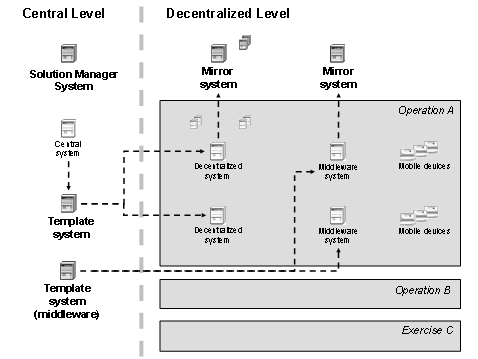
Systems for Administration and Quality Assurance (Simplified Presentation)
The figure shows an example of communication between systems with administration and quality assurance functions for one of three independent system landscape operations.
For more information about operating the system group and distributing data between the systems involved, see System Architecture .