 Net Requirements Planning (10)
Purpose
This planning strategy is particularly useful in mass production environments; it is often combined with repetitive manufacturing. You should choose this strategy if you want production to be determined by a production plan (Demand Management) and if you do not want sales orders to influence production directly. One of the most important features of this planning strategy is that it enables you to smooth the demand program.
Examples from Industry
Strategy 10 is used in the customer packaged goods industry because it is possible to plan the demand for ice cream very easily, for example, while a single order should not affect production.
Strategy 10 is also used for products with seasonal demand where production needs to be smoothed.
Prerequisites
You must maintain the following master data for the finished product:
Strategy group 10 on the
MRP
screen.Item category group (for example, NORM ) on the
Sales Organization
screen.Availability check
field in Customizing so that you perform an availability check without replenishment lead times (in the standard system, you must enter 02 here). For more information see theOther Areas
section below.
Process Flow
For a detailed example of the entire process, see Sample Scenario: Strategy 10 .
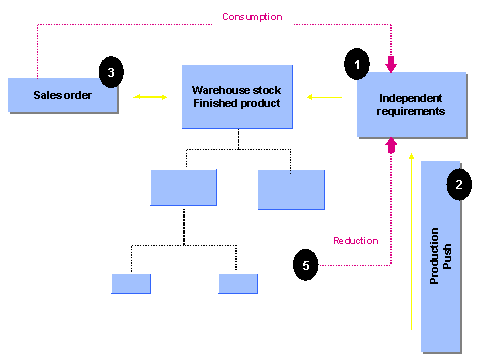
Procurement quantities can be planned relatively effectively by means of planned independent requirements. It is possible to use information from the sales forecast, or from the Sales Information System, or other planning tools to plan production quantities. This means that production and procurement of the required components is triggered before receipt of sales orders.
Procurement is determined by planned independent requirements only. This lends itself to a smoothing of production, which means you can create a smooth production plan that cannot be affected by irregular sales orders.
An accurate availability check is performed according to ATP logic during sales order processing.
Sales orders can be displayed for information purposes only; they do not affect production quantities. Goods are sold from stock in this strategy.
The planned independent requirements are reduced at goods issue for the delivery. This means that you can compare the planned independent requirements situation with the actual customer requirements.
Planned independent requirements that are left unreduced increase the warehouse stock of the finished product and cause procurement to be decreased or not to take place at all in the next period, due to the netting.
If you want the system to reduce future planned independent requirements when it makes withdrawals for unplanned sales orders, you must maintain the appropriate consumption period. See Consumption Strategies and Logic for more information.
Other Areas
Availability Check
You must use an availability check that checks without RLT. See Availability Check .
To switch off the display of the orders, set the
No MRP
indicator to
2
in Customizing (choose

Sales and Distribution

Basic Functions
Availability Check and Transfer of Requirements
Transfer of Requirements
Define Requirements Classes
 ).
).
 Note
Note
Do not leave the
No MRP
indicator field blank. If the requirement is transferred, the consequences may be serious.
This IMG activity is linked to
LSF
in Customizing under
Sales and Distribution
Basic Functions
Availability Check and Transfer of Requirements
Transfer of Requirements
Define requirements types
.