 Financial Statement Imbalances, Deferred Income Tax and Consolidation Unit Balance Adjustment
Use
It can be necessary for both manual and automatic postings to post financial statement imbalances, deferred income tax or consolidation unit balance adjustments. The system checks each manually or automatically generated posting documents whether a financial statement imbalance, deferred income tax or a consolidation unit balance adjustment needs to be posted and generates additional line items, if necessary.
With manual postings, we are talking of automatic line items as the system independently supplements your manually entered document line items with line items.
See following table:
Line items are generated... |
if these conditions are given |
An entry between balance sheet and income statement accounts leads to an imbalance in the financial statements |
|
The given document type supports this feature, and the entry requires an adjustment for financial statement imbalances |
|
To clear imbalances in each individual consolidation unit when posting interunit entries |
The document type supports this feature, and requires a posting level greater than or equal 20 and selected FS items |
Features
You will find detailed explanations for financial statement imbalances, deferred income tax or consolidation unit balance adjustments in the subsequent sections of the Consolidation documentation. In this section functions are explained which are valid for all three kinds of additional line items.
Selected FS items
So that the system can generate individual line items for financial statement imbalances, deferred income tax and consolidation unit balance adjustments, you have to set the following in the Implementation Guide (IMG) of Consolidation:
in step Specify Selected FS Items for Posting enter the items which the system should post for financial statement imbalances and deferred income taxes
 Note
Note
You can set the selected FS items for deferred income taxes per document type and as a result override the settings, which you have executed in step Selected FS Items for Posting .
in the definition of document types (see the step in the respective IMG unit, for example Document Types for Manual Posting )
the indicator post deferred income taxes to the credits to credit deferred income taxes or post deferred income taxes to the debits to debit deferred income taxes (as well as the tax rate in the master records of the consolidation units)
possibly the selected FS items for deferred income taxes (see note above)
the selected elimination FS items for the consolidation unit balance adjustments
Subassignments for these Selected FS Items
The selected FS items for financial statement imbalances, deferred income tax and consolidation unit balance adjustments, which you have defined in the step selected FS items for posting or in the definition of document types, require a breakdown by Subassignment according to the breakdown category.
In Customizing you have various possibilities to control how the system determines the subassignments for the selected items:
Selected FS Items for Financial Statement Imbalances
For every selected FS item, which allows for one or more subassignment, you can set the indicator Default per subassignment and/or enter a you do not set the indicator. The following logic is valid in phases:
When you do not set the indicator Default , then you have to enter the you do not set the indicator. The system then always posts this characteristic value as a subassignment to the selected FS item.
Exception: When it concerns an optional breakdown then you do not have to enter the characteristic value. The system then does not post the subassignment, instead it debits the null value.
When you set the indicator, then you do not necessarily have to enter a characteristic value for the subassignment.
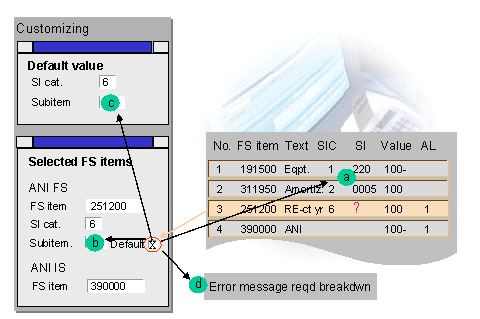
The system goes forward step-by-step in order to determine the subassignment. The graphic shows these steps from a) to d):
 ( )
( )
Explanations:
First the system checks whether it can determine the subassignment from the document.
When a) this is not possible, then it checks whether you have entered the subassignment as a selected FS item.
When b) is not correct, then it takes the subassignment, which you have defined in step Define Default Values for Subassignments .
When c) is unsuccessful and the breakdown category for the subassignment plans a required breakdown, then the system displays an error message.
Note
Step a), therefore the determination of the subassignment from the document is possible when:
the subassignment is clearly in the document, that means the same characteristic value is assigned to an account in all line items with this subassignment
the document per subassignment is divided into a shared document, for which the imbalance over all financial statement items is null (see the graphic example for the clearing item)
Selected FS Items for Deferred Income Tax
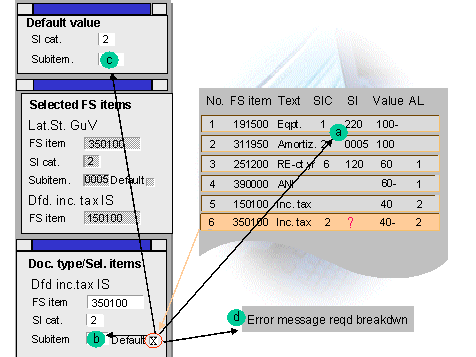
The logic how the system finds the subassignment for selected FS items of deferred income tax, is fundamentally exactly the same as the selected FS items for financial statement imbalances. The only difference is that you can define the selected FS items document type dependent. When posting the system first checks whether the selected FS items are maintained for the document type and defines the subassignments in the way which is explained above.
When the selected FS items are not entered per document type, then it gets the (global) settings in step Define Selected FS Items for Posting and uses the logic there.
 ( )
( )
Selected Clearing Items
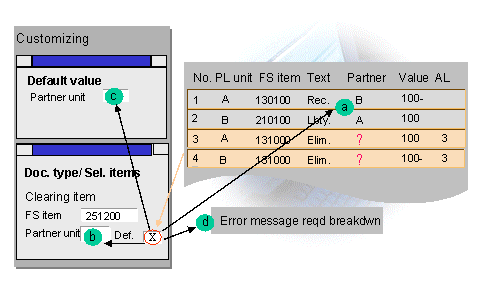
You maintain the selected clearing items per document type. The logic how the system determines the subassignments is the same as for the selected FS items for financial statement imbalances and deferred income taxes.
 ( )
( )
Note
In the example in the graphic, the system can determine the partner assignment from the document in step a) and to be precise
Partner B in row 3
Partner A in row 4
The document is then divided into two shared documents for which the imbalance over all financial statement items is null.
Manual Posting: Help Functions for Automatic Line Items
Simulation
When you enter a posting document in the manual posting transaction, then the system generates the automatic line items while saving the document and subsequently updates the complete document in the database. Before saving the document you can simulate it. The system shows the automatic line items in the simulation. Therefore you can see beforehand whether and how the system will post financial statement imbalances, deferred income tax and/or consolidation unit balance adjustments.
Identification
The system marks the automatic line items with a special number in the document, so that you can differentiate them from your manually entered line items:
Field AUT |
Meaning |
1 |
Automatic line items for financial statement imbalances |
2 |
Automatic line items for deferred income taxes |
3 |
Automatic line items for cross-clearing cons units |
Entering Manually or Correcting Automatic Line Items
Instead of generating the automatic line items by the system, you can also enter these rows manually. You should note the following:
When you want to enter the rows manually, then you have to enter all "automatic" rows.
You have to enter the correct values , that means
the imbalance and the net income or loss of the complete document must be 0
you must post the tax portion in the financial statement imbalances of the complete document to the selected FS items for deferred income taxes
First you can simulate the automatic line items by the system and then change, for example change the subassignments or distribute the simulated values to several document line items.