 Financial Statement Imbalances
Use
Standardizing and consolidation entries can cause an imbalance in the financial statements. For example, an adjustment to depreciation on machinery involves posting in both the income statement and the balance sheet, causing these two statements to become out of balance. This imbalance is calculated by the system and balancing adjustments are automatically posted.
The system posts the financial statement imbalances automatically . This ensures that the balance sheet and income statement are posted consistently. Once the adjustment is posted, the two balance again.
Features
During each posting, the program checks whether any income statement items are being posted with a non-zero balance. If so, it computes and posts a financial statement balancing adjustment.
Where the appropriation of retained earnings are stated also affects the financial statement balancing adjustment:
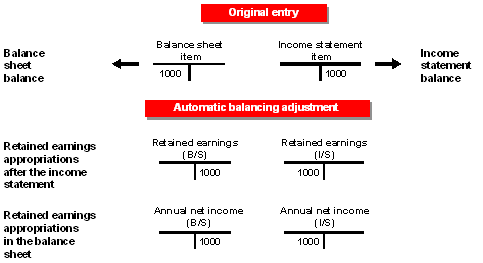
If the appropriations are stated after the income statement, the adjustment is posted to retained earnings items, in the balance sheet as well as the income statement.
If the appropriations are stated in the balance sheet, the adjustment is posted to annual net income items, in the balance sheet as well as the income statement.
You determine the which items are posted to in the Customizing of selected items for retained earnings and annual net income.
The financial statements remain in balance because the balancing adjustment takes both financial statements into consideration.
Example
Assume that after you post a standardizing entry to a balance sheet item, the balance sheet and the income statement are no longer in balance.
The following illustration shows you how the accounts are affected by the original entry as well as the automatic financial statement balancing adjustment. The automatic posting is depicted for both cases of where the appropriation of retained earnings are stated.
 ( )
( )