5.5 Navigation Tree 
You configure the menu tree and extra attributes for the NWBC on the Menu tab page.
Tree Structure
Create the role menu tree according to the usual PFCG procedures. For more information, see Role Menu and the documentation that is displayed by choosing the  (i) icon on the Menu tab page.
 (Menu tab page)
The first node in the tree, labeled Role menu, is a pseudo node that is used to contain the root folder (or folders) as children. This specific node is not part of the navigation tree and is not visualized in NWBC.
A menu tree contains a root folder as the starting point. The root folder is the navigation element at the first level. The root folder is the first element that is rendered within the client. Usually, there is only one root folder per node, but you can specify several root folders.
Below the root folder a menu tree can contain any number of levels. Each level is represented by a folder in the tree. A two or three level menu at the start of your development work is recommended. With a two-level menu, the first level is in the root folder, and the second level contains the transaction items. With a three-level menu, a second folder level comes after the first level, and the transaction items are on the third level.
 (Mapping of PFCG menu tree onto NWBC shell)
You can change the sort sequence of folders and individual menu items by choosing the arrow icons to move items up or down:
 (Arrow icons)
Use drag and drop to move folders to different positions in the tree. For information on troubleshooting-related functions provided in the icon/pushbutton bar, see PFCG.01 Searching for Technical Names.
Types of Programs
Diverse objects can be specified as items in the menu tree according to normal PFCG procedures. To do this, choose the appropriate option of the dropdown list of function Insert node in change mode. Note that each application has its own attribute screen that is dependent on its application type.
 (Insert application)
 Note
Note
Note that you cannot insert applications at level 1 but only folders.
For NWBC, you can insert the following objects in the menu tree:
Transaction code
Web Dynpro ABAP application
BSP application
Web address or file
Generic Web address (URL template)
WebClient UI applications (for systems with WEBCUIF 7.02 upwards, for example, CRM 7.0 EHP1). Note that navigation with NWBC may differ from common look and feel in SAP CRM.
This integration is aimed primarily at users whose applications are not based on the WebClient UI with NWBC and need to access only a few WebClient UI applications. For example, you use Financial Accounting in SAP Enterprise Resource Planning (SAP ERP) and, in addition, you wish to use account details of SAP Customer Relationship Management (SAP CRM).
Users who work primarily with WebClient UI applications should continue to use the standalone WebClient UI to have the full set of features available with WebClient UI components and the roles that were designed for the WebClient UI.
 Caution
All other menu types cannot be displayed in NWBC.
For each folder, you can specify a description, which is used as tooltip in NWBC. You can edit the short text by selecting the folder and choosing Change Folder in the context menu.
If you use Web Dynpro ABAP applications, you can also specify additional application parameters. For more information, see Application Parameters and URL Parameters.
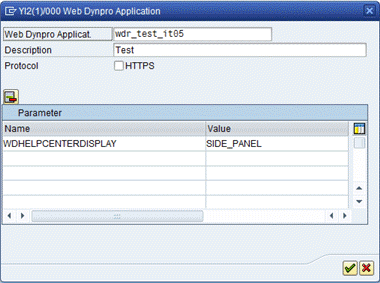 (Example of inserting a Web Dynpro ABAP application)
Other Node Details
For NWBC, detailed attributes are available in PFCG for each folder or node. These additional attributes are used to achieve very specific runtime effects on the NWBC shell. To maintain these attributes, select the relevant folder or node and choose the Other Node Details pushbutton. For more information, see 5.2 Improvements in PFCG User Interface.
 (Other Node Details)
The entries in the menu can have the following attributes:
Level |
Attributes |
|---|---|
Folders at root level |
Folder Option (Service Map, Link Collection, Menu or Side Panel) Single Top Level |
Other folders |
Folder Option (Service Map, Link Collection or Side Panel) |
Single entries (applications) |
Node Option (Side Panel or blank) Application Type Visibility Launch Application |
The settings lead to different visualizations in the shell and content area. The following table describes the settings that you can make under Other Node Details:
Settings on folder level
Field Name |
Level |
Description |
|---|---|---|
Service Map Icon |
* |
You can select the icon that is to be displayed for this role on the service map. For more information, see the field help. |
Work Center Icon |
1 |
You can select the icon that is to be displayed for this role on the navigation tab for the work center. For more information, see the field help. |
Folder Option |
* (except Link Collection and Menu) |
The following options are available:
|
Single Top Level |
1 |
Specifies that this folder is displayed with the root folder on the top of the shell and the second level navigation entries on the navigation panel of the shell. For more information, see 5.8 Single Top Level. |
Settings on Application Level
Field Name |
Level |
Description |
|---|---|---|
Node Option |
* |
Side Panel Specifies that this folder and all its subfolders are side panels applications. |
Application Type |
* |
These options are used to group entries together within home pages that were built by using the Page Builder and that have the correct CHIPs. The following options are available:
|
Visibility |
* |
The following options are available:
|
Launch Application |
* |
The following options are available:
|
Default Page |
* |
Specifies that an application is displayed when the folder is selected. For more information, see 5.6 Default Pages and Service Maps. |
Force SAP GUI in HTML |
* (only SAP GUI transactions) |
Specifies that a transaction is started in SAP GUI, not in SAP GUI for HTML. You can select this checkbox to force a transaction to be started in SAP GUI. Some transactions only run in SAP GUI, but not in SAP GUI for HTML. For information, see transaction SE93. However, note that this information is not always up-to-date. Prerequisite: You have installed SAP GUI on the presentation server. This checkbox is only relevant for NWBC for HTML. |