
 Extended Account Settlement
In extended settlement, you can execute settlement in several independent settlement tracks. There are two types of settlement track:
· Basis Track
· Additional Tracks
The additional tracks enable you to execute interest settlement and charge settlement in two independent settlements with different time periods. It also enables you to depict products that have several interest conditions, which have individual time periods, such as savings products with bonuses.
Settlement tracks of extended settlement
As described above, extended settlement is based on settlement tracks that have cross-settlement track and settlement track-specific attributes:
· Settlement track-specific attributes
¡ Every track has its own individual time period.
¡ Every track has its own conditions. Each track can have one condition group with the condition group category Settlement.
¡ Each track can be settled individually.
¡ You can use the method Execute Alternative Account Settlement for every settlement track.
¡ You can delete every definitive settlement for a track individually.
· Cross -settlement track attributes
¡ Capital yield tax
¡ Post Cumulated Settlement
¡ Exchange conditions
·

· Basis Track
The base track of extended settlement calculates the interest. The base track has the same function as in standard account settlement. You can execute adjustments to previous periods in the base track only. SAP provides the basis track with the track number 001. You cannot delete this track.
· Additional Tracks
The additional tracks of extended settlement calculate the charges. It is not possible to calculate interest conditions using an additional track.
Settlement
If several settlement tracks of an account have the same due date, the additional tracks must be settled first. The base track requires the settlement results of the additional tracks to calculate its own settlement results. If you first execute settlement for the basis track, no further settlements can be executed on this (settlement) posting day.
A posting cut-off is not obligatory for the settlement of additional tracks. If you do not execute a posting cut-off, all postings up to the time of settlement are included. If additional postings are made on the same posting date, but after the time of the settlement, these postings are not included in any settlement. Therefore, we recommend that you execute a posting cut-off for additional tracks also.
Extended settlement of an account locks the account to prevent further postings on the same posting date. Extended settlement makes an exception to this rule for products that have “terms”. You can settle term products and make postings to them on the posting date for account settlement.
If the system determines that several tracks of an account with different due dates are to be settled on a selected date, the system settles only the track that has the oldest due date. The other tracks must be settled in additional runs.
The settlement type controls whether a settlement is definitive or alternative. SAP provides the settlement type 001 as standard, which is for definitive settlement of the basis track. You can define all the other settlement types that you require for definition of definitive and alternative settlement of the additional tracks in Customizing for Account Management under Product Management ®Settlement ® Define Settlement Types.
Example
Example 1
Corporate current account for processing payment transactions (several thousand payment items per month)
Account maintenance charge EUR 25 (Settlement: Quarterly)
Debit Interest 8,5% (Settlement: Quarterly)
Credit interest 0,5% (Settlement: Quarterly)
Item charge EUR 0.12 (Settlement:Monthly)
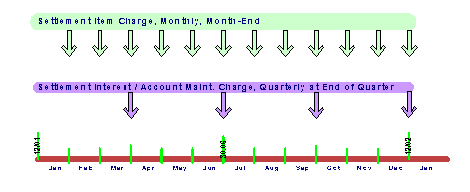 In the example displayed, it is necessary that
customers that have a large number of payment transaction require an exact
monthly calculation of the item charges incurred.
In the example displayed, it is necessary that
customers that have a large number of payment transaction require an exact
monthly calculation of the item charges incurred.
Example 2
Corporate current account for processing payment transactions (several thousand payment items per month)
Account maintenance charge EUR 25 (Settlement: Half-Yearly)
Debit Interest 8,5 % (Settlement: Quarterly)
Credit interest 0,5 % (Settlement: Quarterly)
Item charge EUR 0.12 (Settlement:Monthly)
 This example is a variant of example 1.
The period
for the calculation of the account maintenance charges is different to that
for interest calculation.
This example is a variant of example 1.
The period
for the calculation of the account maintenance charges is different to that
for interest calculation.
Example 3
Passive product that has a bonus interest rate in parallel to the actual credit interest rate. The customer receives the bonus if a specific target is “achieved”.
Product characteristics:
· Credit interest 3 %
· Bonus from total of all deposits 1,5 %
· Target/requirement: No withdrawals in first “year of term”.

Das dargestellte Produkt hat zwei unabhängig voneinander laufende Periodizitäten.The credit interest is calculated according to the calendar year, the bonus interest is calculated on 15.03 and the balance is posted (year of term = Savings year).