 Weighting Procedure
You can only extrapolate from a base period, if it is representative. Whether a period is representative or not is a result of the original weighting procedure.
The weighting procedure involves internal system procedures that are applied to existing meter reading results, period consumption values or period demand values, in order to determine expected values for extrapolation and proration
Weighting procedures are predefined as:
Linear weighting
Weighting of energy feeding
Degree day weighting
Sprinkling water portion
General weighting
You must define the following with regard to weighting procedures in Customizing:
Weighting key
You can define weighting key in Customizing for
SAP Utilities
under
 Device Management
 Meter Reading
Weighting Procedure
Define Weighting Key
Meter Reading
Weighting Procedure
Define Weighting Key

Allocate user-defined weighting keys to weighting procedures predefined by SAP.
For further information read the documentation for the IMG Activity.
Weighting unit
You can define weighting units in Customizing for
SAP Utilities
under
Device Management
Meter Reading
Weighting Procedure
User-Defined Weighting
Define Weighting Unit.
A weighting unit is a fixed value, such as energy feeding volume or issue quantity of energy or water that was issued in a certain period in a service territory.
The periods for the distribution of weighting units are always indicated by the month or day and are year-independent.
The weighting portion of a certain period results from the relationship of the weighting units for this period, to the total weighting units for a year.
Example:
 ( )
( )
The sum of the weighting units for one year is 1000.
Weighting units valid from 01.01 (100) : Total weighting units (1000)
= Weighting portion from 01.01 to 02.01. (10%)
For further information read the documentation for the IMG Activity.
You must also enter the following in the Utilities Industry menu:
Minimum portion in percent
Enter the minimum portion in percent, in the rate. The rate is under the following path in the
Utilities Industry
menu:
Billing
Master Data
The minimum portion in percent is used to determine the minimum requirements for the representativeness of the base period.
If you enter a low minimum portion in percent, the meter reading results are used from a short period for extrapolation.
If you enter 100% as the minimum portion, the system uses the existing meter reading results as a basis for extrapolation, as long as meter reading results are available for a complete billing period.
Period length of the portion
Enter the period length in the portion. The portion is under the following path in the
Utilities Industry
menu:
Scheduling
Schedule Master Record.
The period length of the portion defines the intervals for billing the associated contracts.
Linear weighting
The linear weighting procedure does not take seasonal fluctuations into account. For linear weighting, the weighting units are distributed equally over the year, whereby the system takes one weighting unit into account for each day. The total of the weighting values is 365 for one year or 366 for a leap year.
Weighting of energy feeding or degree day weighting
These weighting procedures take seasonal fluctuations into account.
 ( )
( )
The total weight for one year is 1000.
The weighting portion for January is 200: 1.000 = 20%
The weighting portion for February is 150: 1.000 = 15%
and so on.
User-defined weighting
In addition to the weighting procedures defined by SAP, you can define your own weighting procedures.
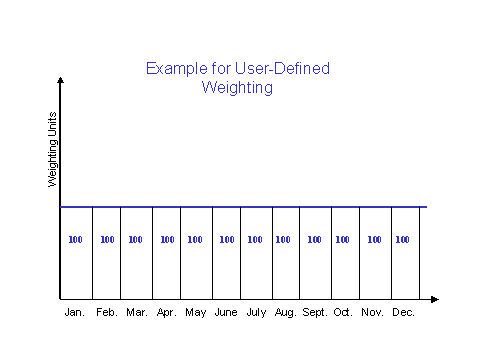 ( )
( )
The total weight for one year is 1,200.
The weighting portions for months January to December are 100: 1.200.
Mixed weighting procedure
The mixed weighting procedure also takes seasonal fluctuation into account.
Enter the weighting key in the rate for the weighting of energy feeding procedure, degree day weighting procedure or for the sprinkling water portion. Enter a consumption fixed value to be weighted linearly or a consumption percentage for weighting in the installation structure at register level or in the register data during device installation.
The consumption value to be weighted linearly is a fixed value per day that is weighed linearly for extrapolation, independently of the weighting procedure (for example, 5 weighting units per day).
The consumption percentage for weighting is a percentage portion of the total weighting units per day. It is split linearly for extrapolation, independently of the weighting procedure (for example, 20% of the total weighting units per day).
The absolute or percentage sprinkling water portion, not taken into account for wastewater calculation, is specified for the water division. The difference between the applied fresh water quantity and the sprinkling water portion is equal to the waste water portion to be calculated.
If you enter a consumption value to be weighted linearly, you must also enter a validity period for which this value is taken into account
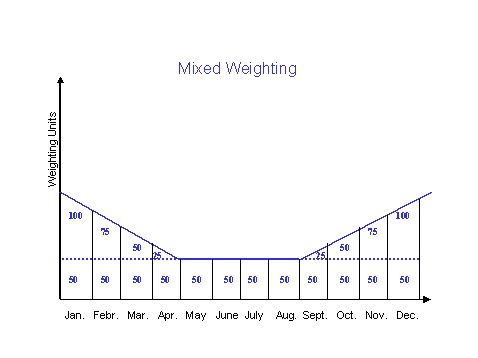 ( )
( )
The total weight for one year is 1,100.
The weighting portion for January is 150: 1.100.
The weighting portion for February is 125: 1.100.
and so on.
Determining whether a period is representative
To determine whether a base period is representative, use the following calculation:
Minimum portion in percent * Length of meter reading period
= Minimum length of base period
or
Weighting portion of period = Minimum portion
Example:
The following meter reading reasons exist:
P eriodic meter reading
F inal meter reading
Meter reading at move-in ( M )
Meter reading at installation ( I )
Interim meter reading without billing ( Y )
Interim meter reading with billing ( Z )
C ontrol meter reading
The period length of the portion is 1 year (365 days)
The minimum portion defined in the rate is 50%
 ( )
( )
The minimum requirements to determine whether the base period is representative are determined as follows:
Minimum portion in percent (50%) * Length of meter reading period (365 days)
= Minimum length of base period (182.5 days)
In the example, the previous period must be at least 182.5 days in order to be representative.
or
Weighting portion of period = Minimum portion
In the example, the base period must include at least 50% of all weights.
The period from P to Y is not representative because it does not have the minimum weighting portion (only 20% rather than the required 50%). This means that this period alone cannot be used as a basis for extrapolation. The system goes back to the next meter reading (I). The period from P to I is representative because it has a weighting portion of 20% + 60% = 80%. The period from P to I can be used as a basis for extrapolation.