 Extrapolation
In order to determine the expected consumption or the expected performance for a register on a specific date, you need data on the metering patterns of the register.
You can take this information from previous meter reading results, from a predefined periodic consumption value or from a predefined period demand.
The base period from which the expected values are calculated is very important during extrapolation. The period in which bases are created to determine expected values during extrapolation are included in the base period. Using the base period category field in the installation, you can control whether to extrapolate the expected values based on the previous period or the period of the previous year.
Meter reading results are the ideal base from which to determine expected values, as these results best reflect the consumption patterns of the customer. In order to use meter reading results, you must ensure that the base period (the interval between the first and the last meter reading result) used for extrapolation is representative.
You can only extrapolate from a previous period, if it is representative. Whether a period is representative or not is a result of the original weighting procedure.
Determining Whether a Period is Representative
To determine whether a base period is representative, use the following information:
Weighting portion of period = Minimum portion
or
Minimum portion in percent * Length of meter reading period
= Minimum length of base period
Example
The following meter reading reasons exist:
P eriodic meter reading
F inal meter reading
Meter reading at move-in ( M )
Meter reading at installation ( I )
Interim meter reading without billing ( Y )
Interim meter reading with billing ( Z )
C ontrol meter reading
The period length of the portion is 1 year (365 days)
The minimum portion defined in the rate is 50%
The minimum requirements to determine whether the base period is representative are determined in the following way:
Weighting portion of period = Minimum portion
or
Minimum portion in percent (50%) * Length of meter reading period (365 days)
= Minimum length of base period (182.5 days)
In the example, the base period must have a minimum weighting portion of 50% or be at least 182.5 days long in order to be representative.
 ( )
( )
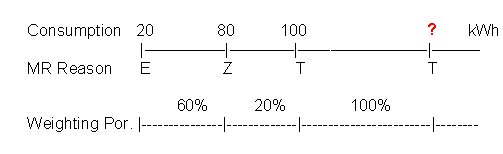
The period from P to Y is not representative because it does not have the minimum weighting portion (only 20% rather than the required 50%). This means that this period alone cannot be used as a basis for extrapolation. The system goes back to the previous reading (I). The period from P to I is representative because it has a weighting portion of 20% + 60% = 80%. The period from P to I can be used as a basis for extrapolation.
Meter Reading Results or Period Value as a Basis for Extrapolation
The system determines whether to use meter reading results or a selected period value as a basis for extrapolation in the following way:
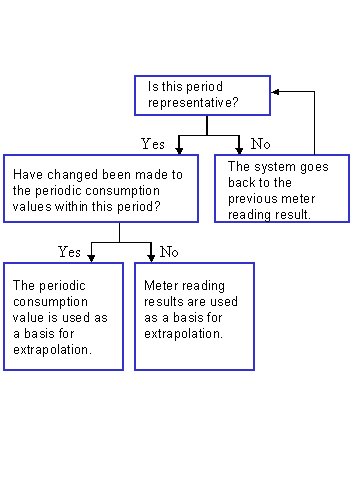
Based on the last correct meter reading results, the system goes back to the previous reading and runs through the following process:
 ( )
( )
If you enter a modified periodic consumption in transaction Maintain Periodic Consumption (EL 56) for a point in time that lies within the base period for the next extrapolation, the system will inform you that the entered periodic consumption can influence the extrapolation results.
Determination of Expected Consumption for Consumption Registers
Determination of the expected consumption based on the meter reading results
You can calculate the consumption per unit of weight from the determined consumption and the determined weight of the base period:
Determined consumption of base period: Determined weight of base period
= Consumption per unit of weight
To determine the expected consumption of the forecast period, multiply the consumption per unit of weight by the weight of the forecast period.
Consumption per unit of weight * Weight of forecast period
= Expected consumption of forecast period
The expected meter reading is calculated from the expected consumption with the help of special parameters (register factor, billing factor, dimension conversion table).
Determination of the expected consumption based on the period consumption
The following reasons can result in the period consumption being used as a basis for extrapolation:
Not enough meter reading results are available
You entered the period consumption before a representative point in time was created by the updating of meter reading results
The expected consumption is determined in the following way:
The consumption per unit of weight is calculated from the period consumption and the weight of its validity period:
Period consumption Weight of the period consumption validity period
= Consumption per unit of weight
To determine the expected consumption of the forecast period, multiply the consumption per unit of weight by the weight of the forecast period:
Consumption per unit of weight * Weight of forecast period
= Expected consumption of forecast period
The expected meter reading is calculated from the expected consumption with the help of special parameters (register factor, billing factor, dimension conversion table).
Determination of the Expected Demand for Demand Registers
Determining the expected demand for demand registers is a similar process to determining the expected consumption for consumption registers. Demand per unit of weight is, however, not calculated. In this case, you must determine the highest demand for the base period.
Determination of the expected demand based on the meter reading results
Determination of the highest meter reading in the base period
The determined demand corresponds to the expected demand
Determination of the expected demand based on the period demand
The following reasons can result in the period demand being used as a basis for extrapolation:
Not enough meter reading results are available
You entered the period demand before a representative point in time was created by the updating of meter reading results
The expected demand is determined in the following way:
Determination of the period demand
The determined period demand corresponds to the expected demand