 Extrapolation for Demand Registers
In the case of demand registers, the highest demand is taken into account in a representative interval as an expected value, in order to determine expected meter readings from the previous period. In the case of cumulative demand registers, the highest demand difference is taken into account.
Expected meter readings for demand registers are determined as follows:
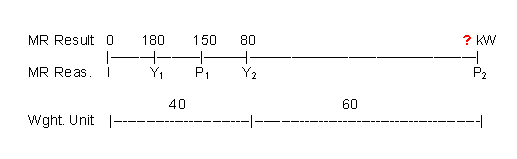
Determination of the highest meter reading from previous reading Y 2 over a representative interval (Y 2 to I):
180 kW
Determined demand = expected demand:
180 kW
When you calculate expected meter reading values from existing meter readings, you must take the minimum portions into account. In the previous example, we assume that period Y 2 to I is representative.
Demand registers always refer to the linear weighting procedure in their rate.
 Note
Note
If demand needs to be extrapolated for billing, the expected meter reading values are determined differently. For more information, see Extrapolation of Demand from Billing .
Forecasts from Previous Periods
If you include previous periods as the base period category in the installation, the expected meter reading values are calculated based on the corresponding previous period .
In the following example, we assume that the demand registers are balanced.
Example 1:Forecasts from previous periods with minimum portions
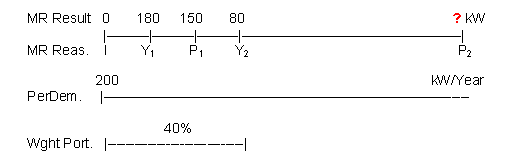
On installation of the device, a period demand value of 200 kWh/year is entered for the register.
The minimum portion of weighting in percent is 30%.
The sum of the weighting units for one year is 1000.
With a weighting portion of 40%, period Y 2 to I is representative. This means that extrapolation is based on meter reading results rather than on the period demand.
Determination of the highest meter reading from previous reading Y 2 over a representative interval (Y 2 to I):
180 kW
Determined demand = expected demand:
180 kW
The expected meter reading at time P is 180 kWh .
Example 2:Forecasts from previous periods without minimum portions with period demand

On installation of the device, a period demand value of 200 kWh/year is entered for the register.
The minimum portion of weighting in percent is 30%.
The sum of the weighting units for one year is 1000.
With a weighting portion of 20%, period Y to I is not representative. Therefore, extrapolation is based on the period demand rather than on the meter reading results:
The expected meter reading result is 200 kW .
Example 3: Forecasts from previous periods and changes to period demand in the base period

On installation of the device, a period demand value of 200 kWh/year is entered for the register. This value is changed to 220 kWh / year for the period I to C.
The minimum portion of weighting in percent is 30%.
The sum of the weighting units for one year is 1000.
With a weighting portion of 10%, period Y to C is not representative. The system goes back to the next meter reading result (I). With 40%, the period Y to I is representative, however, the period demand was changed within this period. Therefore, extrapolation is based on the period demand rather than on the meter reading results:
The expected meter reading result is 220 kW .
Example 4: Forecasts from previous periods and changes to period demand not in the base period
As no changes were made to the period demand within the base period, extrapolation is based on meter reading results rather than on period demand.
Example 5: Forecasts from previous periods and changes to period demand in the forecast period
The period demand can still be changed after the last meter reading result entry during the forecast period. This results in the following:

On installation of the device, a period demand value of 200 kWh/year is entered for the register. This value is changed to 220 kWh / year after the last meter reading result entry in period Y to P.
The minimum portion of weighting in percent is 30%.
The sum of the weighting units for one year is 1000.
With a weighting portion of 40%, period Y to I is representative. One period consumption change was made in the forecast period Y to P. The expected meter reading is determined based on the period demand and equals 220 kW .
Forecasts from the Period of the Previous Year
If you include periods of the previous year as the base period category in the installation, the expected meter reading values are extrapolated based on the corresponding period of the previous year .
For the forecast from the period of the previous year, the search algorithm for demand registers differs from the search algorithm for consumption registers as follows:
Demand Registers |
Consumption Registers |
The system only looks for meter reading results in the previous year with the same allocation month as the expected meter readings |
The system goes back one year from the forecast date and looks for a representative period |
It is not important whether the period of previous year is representative |
It is important that the period of previous year is representative |
If no corresponding period of the previous year is available, extrapolation is based on the previous period.

P(4) = periodic meter reading for allocation month April
P(5) = periodic meter reading for allocation month May, and so on
The expected meter reading for P(5) is determined based on the demand with the same allocation month from the period of the previous year (P(5) = 120 kW)
The expected meter reading result is 120 kW .
Example 6:Forecasts from the period of the previous year and changes to period demand in the base period

Period demand was changed in the period P(5) to P(4). This change does not, however, influence extrapolation for time P(5) (5.1.97), because a change in period demand only influences the forecast period that follows directly after.
The expected meter reading for P(5) is determined based on the demand with the same allocation month from the period of the previous year (P(5) = 120 kW)
The expected meter reading result is 120 kW .
Example 7:Forecasts from period of the previous year and changes to period demand in the previous year but not in the base period
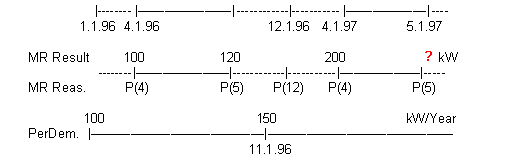
On 1.1.96 a period demand value of 100 kWh / year was entered for the register. On 11.1.96 for the period P(5) and P(12) this value was changed to 150 kWh / year.
No changes were made to the period demand in the period P(5) to P(4). The changes that were made to the period demand between P(5) and P(12) do not influence extrapolation for time P(5) (97.5.1),because changes to the period demand only influence the forecast period that follows directly after.
The expected meter reading is determined as in example 6.
Example 8:Forecasts from the period of previous year and changes to period demand in the forecast period
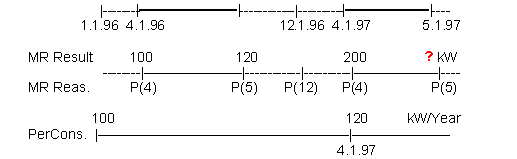
On 1.1.96 a period demand value of 100 kWh / year was entered for the register. On P(4) (4.1.96), this was changed to 120 kW / year.
In contrast to consumption registers, and in the case of demand registers, meter reading results have priority over changes to period demand in the current forecast period.
Therefore, if the system finds a meter reading result with the same allocation month in the period of the previous year, this result is used for extrapolation instead of the period demand.
The expected meter reading for P(5) is determined based on the demand with the same allocation month from the period of the previous year (P(5) = 120 kW)
The expected meter reading result is 120 kW .
Example 9:Forecasts from period of previous year but period of previous year does not yet exist
If you enter period of previous year in the installation of the base period category but no period of previous year exists (because there has only been a contractual relationship with the customer for half a year for example), extrapolation is based on the previous period, as in the case of consumption registers.