
 Availability Check and Planning in SAP APO
Purpose
If you carry out planning using SAP Advanced Planning and Optimization (SAP APO), we strongly recommend that the requirements are posted in SAP APO when the sales order is saved in CRM Enterprise. The standard system is set to this process. You need to use an SAP APO 3.0A or a higher release.

If you still need to carry out planning using SAP ECC, see Availability Check in SAP APO, Planning in SAP ECC.
Process Flow
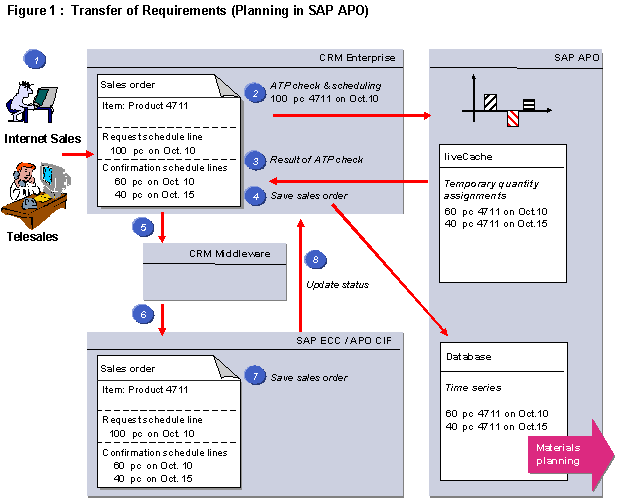
The following illustration (Figure 1) shows the data flow between CRM Enterprise and SAP APO:
...
1. Depending on the business scenario used, a sales order is entered in or transferred to CRM Enterprise. The product is entered on item level, the quantity and requested date are entered in the request schedule line.
2. A product availability check is carried out for 100 pc of product number 4711 to be delivered to the customer by Oct.10.
3. SAP APO returns the following results to CRM Enterprise:
¡ 60 pc can be delivered by Oct. 10
¡ The remaining 40 pc cannot be delivered until Oct. 15
It also determines the location (delivering plant). For more information, see Location Determination in the Sales Order.
In CRM Enterprise, confirmation schedule lines are generated for the confirmed results.
In the SAP APO liveCache, requirements are created for these results in the form of temporary quantity assignments.
Temporary quantity assignments block the quantities for subsequent sales orders when product availability check is carried out, but are not relevant for materials planning.
The temporary quantity assignments consist of both internal and external objects. For more information, see the documentation for the TOIn field in the Implementation Guide (IMG) for SAP APO under Global Available-to-Promise (Global ATP Check) ® General Settings ® Maintain Requirements Profile.
4. The sales order is saved in CRM Enterprise.
The temporary quantity assignments are deleted from the SAP APO liveCache; the requirements are saved in SAP APO as time series. The time series are taken into account for product availability check and are also relevant for materials planning.
5. The sales order is transferred to CRM Middleware as a business document.
6. From CRM Middleware the sales order is transferred to SAP ECC.
7. The sales order is saved automatically in SAP ECC.
There is no data transfer between the sales order in SAP ECC and SAP APO.
8. In the Status tab in the sales order header in CRM Enterprise, under the section R/3 transfer and R/3 status, the Distribution status field is set tosuccessfully distributed.
In case the sales order is not successfully transferred, error messages are displayed in the application log. The system deletes these error messages from the application log after the sales order is transferred successfully to SAP ECC at a later stage.
Restrictions
The following processes for the ATP check are not supported in CRM Enterprise:
· Assembly processing
· Third-party order processing
· Rescheduling in SAP ECC
· Availability check against planning
· Availability check triggering production
Once an item has been partially delivered, you cannot carry out availability check for this item.
You can carry out availability check against allocations if you use SAP APO 3.1 or higher.
Additional Information
For more information on the sales
order, see the SAP Library for Customer Relationship Management under  Sales
Order.
Sales
Order.