 Dynamic Preinvestment Analysis
Dynamic Preinvestment Analysis
Use
Unlike the static methods of preinvestment analysis, in dynamic preinvestment analysis, the incoming and outgoing payments are viewed differentiated in terms of time, during the whole investment time frame. Since for an investment it is typical that the payments vary during the lifetime of the investment object, dynamic methods are a more precise decision instrument, but which of course require more information about the investment project. In the data entry layouts this has the effect that the data is not entered for one time period per planning version, instead it must be entered for many. In the example delivered, an entry related to years is worked with for a six year investment time frame. However, by copying the example delivered, you can also define similar data entry layouts, in which the analysis period or the time unit (period instead of year) is different.
The methods presented here for dynamic investment calculation are also described as discounted cash flow methods.
Features
Business Content
The Business Content for dynamic preinvestment analysis delivered with SEM-BPS, is made up of the following central planning objects:
The following methods are used with dynamic preinvestment analysis:
Net Present Value Calculation
The net present value of an investment is calculated according to the following formula:
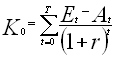
K0: net present value
T: investment duration
t: year, runs from 0 to T
Et: incoming payment in year t
At: outgoing payment in year t
r: Conventional rate of interest
You talk about a net present value, because all incoming and outgoing payments, which are transacted during the investment time frame, are applied with help of a discount to the time immediately before the investment. An investment is then only economically sensible if it results in a capital value greater than zero.
Internal Interest Rate Method
One criticism of the capital value method is that a conventional rate of interest is entered in the calculation, which it is very difficult to estimate. This is not necessary using of the internal interest rate. The following formula is used:
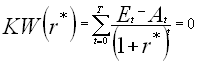
r*: internal interest rate
KW(r*): capital value at the internal interest rate r*
The difference here is that in this procedure the interest rate is not entered, instead it is calculated with a zero value definition. From a mathematical point of view it is to be considered that it is not always possible to find a zero position, or that there are several. However, in practice the internal interest rate can almost always be determined, since with an investment, the outgoing payments are typically larger at the start than the incoming payments, and this reverses itself at a certain point.
See also:
Scenario: Dynamic Preinvestment Analysis