 Scenario: Dynamic Preinvestment Analysis
Scenario: Dynamic Preinvestment Analysis
Planning layouts are available for data entry, which refer to exactly one implementation possibility; every implementation possibility corresponds to one of the planning versions
PC1 , PC2 or PC3 . In the columns, you enter the values for every year in the investment time frame. The costs, revenue, cash flow, and the capital value are displayed in the rows.Eight years are planned as the investment time frame. Variables are used for the definition of fiscal years in the planning layout (the same as for some other characteristics). This offers the possibility to reuse the layout at a later point (for instance in the following approval year). Then you must only change the value of the variable in one central place – namely in the context of the planning area with variable definition. You can then reuse the layouts themselves without any additional changes.
In addition, planning functions are prepared with which the cash flow and capital value are calculated. The versions can be copied with other planning functions. Different planning functions are put together in
 Planning Sequences, so that all values to be calculated can be determined in one step. Furthermore, planning sequences ensure that the individual steps are executed in a sensible order.
A further planning level is used for the comparison of different plan versions. The level contains a layout in which the years are presented in the columns, and the versions in the rows. A graphic is also contained in this layout, so that the capital value of different versions can be compared very easily.
To execute this process, various planning methods are available. For example, it is necessary for the comparison to aggregate all material groups over the variable costs and revenue.
Sensitivity Analysis of the Capital Value
In the planning level PIA dynamic – Sensitivity analysis (
4IMWRDY8 ), a planning layout is available with which you can carry out a sensitivity analysis of the capital value. In this, out of the five incoming measures (sales price, sales quantity, fixed costs, variable costs, investment volumes), one is varied by a specific percentage, while the remaining four values remain constant. Finally, the capital value is calculated again over the investment time frame, and presented in a graphic. The following table shows how the variation has an effect on each of the key figures in the capital value by +/- 20%:Varied Key Figure |
-20% |
0% |
+20% |
Sales price |
-617,105.98 |
1,158.156.42 |
2,933,418.82 |
Sales quantity |
228,577.87 |
1,158,156.42 |
2,087,734.97 |
Fixed costs |
1,376,630.01 |
1,158,156.42 |
939,682.83 |
Variable costs |
2,003,840.27 |
1,158,156.42 |
312,472.57 |
Investment volume |
1,658,156.42 |
1,158,156.42 |
658,156.42 |
In addition the graphic reveals the effects for all variation percentages between -20% and +20%:
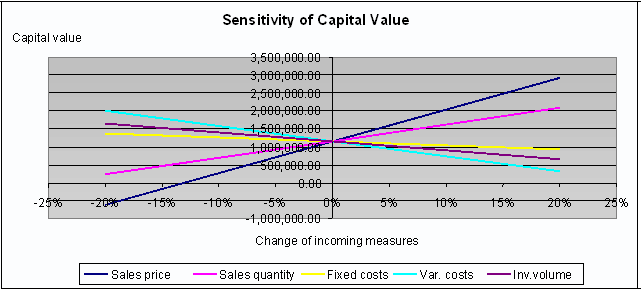
Therefore, the change of the sales price of produced goods has the strongest effect on the capital market, while a change of the fixed costs, which are linked to production, produce the smallest effect.