 Source Allocation Scheduling Logics I and II: Example

Source Allocation Scheduling Logics I and II: Example
You want to execute a source allocation run in the background with rescheduling.

Purchase Requisition |
Requirements Quantity |
Delivery Date |
Capacity Consumption Point |
B1 |
200 pieces |
December 15, 2000 |
December 11, 2000 |
B2 |
100 pieces |
December 15, 2000 |
December 11, 2000 |
B3 |
180 pieces |
November 30, 2000 |
November 24, 2000 |
B4 |
20 pieces |
December 15, 2000 |
December 11, 2000 |
The capacity of your vendor is as follows:
October 2000 |
November 2000 |
December 2000 |
300 pieces |
200 pieces |
100 pieces |
Assigning the Vendor Capacity with Scheduling Logic I
If you choose the
source allocation scheduling logic I, the system first tries to assign the purchase requisition B1 to the capacity period December and fails. In the second step, the system assigns B2 to the capacity period December. The system then assigns B3 to the capacity period November. Just like B1, B4 cannot be assigned because there are no more free capacities in December.

In the second program run, the purchase requisitions B1 and B4 should be rescheduled. The system attempts to assign B1 to the next period November and fails because the requirements quantity exceeds the free capacity quantity. B4 can, however, be assigned to the capacity period November:
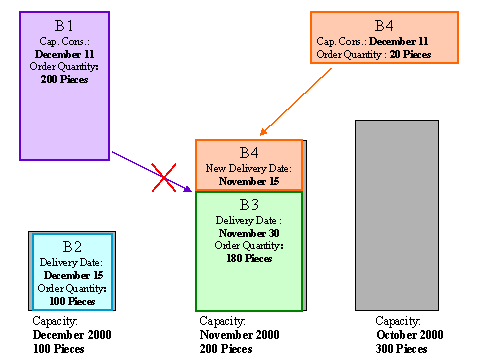
In the third program run, B1 is assigned to the capacity period October. The cumulative capacity consumption is as follows:

Assigning the Vendor Capacity with Scheduling Logic II
If you work with the
source allocation scheduling logic II, the system attempts to assign the first purchase requisition to the capacity period December. Since there are not enough capacities available in December, the system assigns B1 to the next capacity period November:

In the second step, the system assigns the second purchase requisition to the capacity period December:

In the third step, B3 should be assigned. The system attempts to assign the third purchase requisition to the capacity period November and fails because the available capacity has already been consumed by the allocation of B1. B3 is then scheduled backwards to the capacity period October:

In the final program run, the system attempts to assign B4 to the capacity period December and then to November. B4 is ultimately assigned to the capacity period October.
