Example of Disaggregation and Rounding
This example shows how a key figure is disaggregated under the following conditions:
You have defined the month and week periodicity for the planning area.
The planning area contains three characteristics: sales organization, location, and product.
For the key figure, you use the
Pro Rata
calculation type and the
Proportional Distribution
time-based disaggregation type.
No key figure values currently exist.
Data entry happens on the sales organization level.
Planning is done on a monthly basis; that is, the time buckets profile attached to the data view contains months only.
Technical Periods
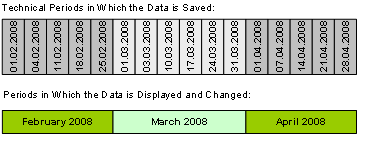
The system saves the data in technical periods. In a week containing a transition from one month to the next, there are two technical periods. This allows the system to distinguish data in different months.
Characteristic Value Combinations
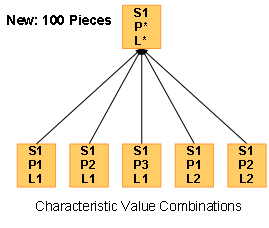
You load the data for the sales organization S1 in interactive planning. The following characteristic value combinations exist for sales organization S1:
Sales Organization |
Product |
Location |
|---|---|---|
S1 |
P1 |
L1 |
S1 |
P2 |
L1 |
S1 |
P3 |
L1 |
S1 |
P1 |
L2 |
S1 |
P2 |
L2 |
You enter 100 pieces as the demand quantity in the month of March.
Data Selection for Sales Organization S1
Time-Based Disaggregation
The system performs time-based disaggregation first. That is, it first disaggregates the 100 pieces of the sales organization S1 level into the technical periods. When doing this, the system uses the number of workdays in each period as a basis, since the key figure does not contain any values yet. In our example, no factory calendar was defined, so the system assumes there are seven workdays in each week. The month of March has 31 workdays. The calculation is as follows:
Technical Period |
Number of Days in Technical Period |
Calculation |
Rounded Value |
Remainder |
|---|---|---|---|---|
01.03 |
2 |
100 * 2/31 = 6,4516… |
6 |
0,4516... |
03.03 |
7 |
100 * 7/31 = 22,5806... |
22 |
0,5806... |
10.03 |
7 |
100 * 7/31 = 22,5806.. |
22 |
0,5806... |
17.03 |
7 |
100 * 7/31 = 22,5806... |
22 |
0,5806... |
24.03 |
7 |
100 * 7/31 = 22,5806... |
22 |
0,5806... |
31.03 |
1 |
100 * 1/31 = 3,2258... |
3 |
0,2258... |
Total: |
97 |
3 |
For each technical period, the system determines the exact proportion and rounds this value according to the degree of accuracy being used for the key figure. In our example, we use the
No Decimal Place
option for the degree of accuracy of the key figure.
The system now distributes the remainder of 3, which it totaled up from the individual remainders of all the periods. The remainder is split into a number of proportions, each one being equal to the smallest possible unit (see Rounding in Demand Planning ). Each period is then assigned such a proportion in sequence (according to the ranking order of the remainders – starting with the highest). In the case of periods that have the same ranking order, a random distribution of the proportions occurs to prevent a build-up of remainders in adjacent periods.
Technical Period |
Remainder from Level 1 |
Ranking Order of Remainder |
Proportion |
Result |
|---|---|---|---|---|
01.03. |
0.4516... |
0 |
6 |
|
03.03. |
0.5806... |
1 |
23 |
|
10.03. |
0.5806... |
0 |
22 |
|
17.03. |
0.5806... |
1 |
23 |
|
24.03. |
0.5806... |
1 |
23 |
|
31.03. |
0.2258... |
0 |
3 |
|
Total: |
100 |
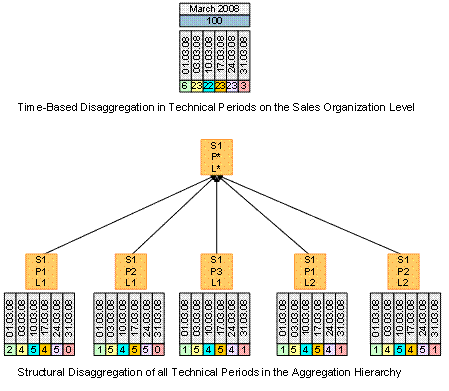
The total result of time-based disaggregation on the sales organization S1 level is as follows: The system allocates 6 pieces to the first technical period March 01 (two workdays). The system allocates 23 pieces to each of the subsequent periods March 03, March 17, and March 23 (7 workdays each) based on the random distribution of the proportions of the remainder. The period March 10 (seven workdays), which has equal ranking, does not receive a proportion of the remainder and therefore only receives 22 pieces. The system assigns 3 pieces to the final period March 31 (1 workday).
Structural Disaggregation
The system then performs structural disaggregation in the aggregation hierarchy. This means that the system distributes the data from the aggregated level at detailed level, and in doing so uses the calculation type of the key figure (in this case pro rata).
For each technical period, the system distributes the values that were determined in advance by time-based disaggregation, individually from the sales organization level to the five characteristic value combinations. Since no key figure values currently exist, the system distributes the data evenly according to the calculation type being used. The rounding logic and the distribution of the remainder that are used here correspond to the methods described above in the
Time-Based Disaggregation
section. In any case, the system does not use random distribution when distributing the remainder for characteristic value combinations with the same ranking order. Instead, it assigns the determined proportions in consecutive order. To avoid an accumulation of remainders for individual characteristic value combinations, the system records for each disaggregation of values in a technical period, the last characteristic value combination where it added a remainder. In the next period, the system starts with the next characteristic value combination when continuing to allocate the remainder.
In the following example, the 23 pieces that are to be distributed in the technical period March 03, are divided for the five characteristic value combinations:
Characteristic Value Combination |
Calculation |
Rounded Value |
Remainder |
|---|---|---|---|
P1 L1 |
23 * 1/5 = 4.6 |
4 |
|
P2 L1 |
23 * 1/5 = 4.6 |
4 |
|
P3 L1 |
23 * 1/5 = 4.6 |
4 |
|
P1 L2 |
23 * 1/5 = 4.6 |
4 |
|
P2 L2 |
23 * 1/5 = 4.6 |
4 |
|
Total: |
20 |
3 |
After determining the proportion and rounding of these values, the system distributes the remainder of 3 across the five characteristic value combinations according to the ranking order of the remainders. All the characteristic value combinations in our example have equal ranking. Before the disaggregation of the values in the technical period March 03 occurs, the values of the technical period March 01 are distributed. Here, exactly one remainder allocation took place for the first characteristic value combination P1 L1. Therefore, the allocation of the remainder for the next period starts with the second characteristic value combination P2 L1. The system allocates the remainder for characteristic value combinations with the same ranking order consecutively until the remainder is completely distributed.
Characteristic Value Combination |
Remainder from Level 1 |
Ranking Order of Remainder |
Proportion |
Result |
|---|---|---|---|---|
P1 L1 |
0 |
4 |
||
P2 L1 |
1 |
5 |
||
P3 L1 |
1 |
5 |
||
P1 L2 |
1 |
5 |
||
P2 L2 |
0 |
4 |
||
Total: |
23 |
The system performs the calculation for each technical period one after the other.The following figure shows the total results schematically: