 Rounding in Demand Planning
Use
Rounding is essential to the understanding of calculations that are made in Demand Planning.
 Note
Note
The system always first performs disaggregation on a time basis and then on a structural basis, while taking account of the calculation type. Since the system performs rounding in both cases, the rounding effects can be amplified. For that reason, we recommend that you work with large values, in other words, small units of measure. We also recommend that you plan using the same periodicity and only use different periodicities for display purposes.
Accuracy of Numbers
Internally, Demand Planning uses floating point arithmetic, for instance, for macros and forecasting (see Number ). In interactive planning, you can display numbers with up to six decimal places. As standard, the system takes the number of decimal places from the unit of measure.
In Demand Planning, you can specify the number of decimal places for each key figure. Before converting from the internal format used in interactive planning to the liveCache format, the system first converts to the format specified in the key figure. In this case, the system rounds to the nearest whole number (that is, a number less than 0.5 is rounded down; 0.5 and greater are rounded up).
The system then converts the format of the key figure into the liveCache format. liveCache uses a fixed number format of 12.3; that is, 12 places before the decimal point, and three after. When converting to the liveCache format, the system rounds to the nearest whole number.
Example for Handling Decimal Places in Interactive Planning and in liveCache
The value 3.58225 has been entered in a cell in interactive planning. The value that is finally saved in liveCache can be different, depending on the number of decimal places defined for the key figure.
Number of Decimal Places in the Key Figure |
Intermediate Value |
Value in liveCache |
0 |
4 |
4.000 |
1 |
3.6 |
3.600 |
2 |
3.58 |
3.580 |
3 or more |
3.582 |
3.582 |
Disaggregation and Rounding
Rounding effects are most noticeable when you work with integer values, for example, with pieces, bottles, or pallets. The following calculation example shows how the system performs rounding if characteristic values already exist for a selection. If, as in this example, you use the calculation type
Pro Rata
, these existing characteristic values are taken into account as proportional factors; in other words, the new characteristic values are distributed proportionally to the old values.
To see another, more detailed example of disaggregation (albeit without proportional factors), see Example of Disaggregation and Roundung .
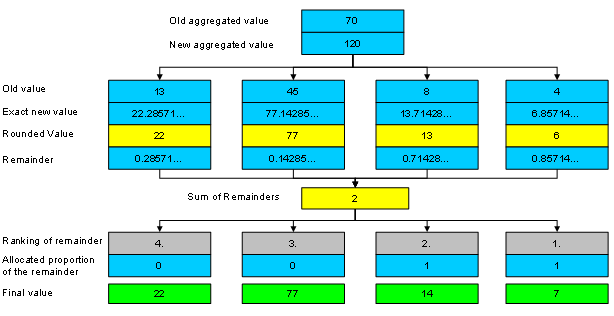
The system performs the calculation as follows:
The system determines the exact proportions for each characteristic value combination and rounds these values according to the chosen degree of accuracy for the key figure. In the example presented here, the system rounds to zero decimal places.
For each characteristic value combination, the system determines the difference between the exact value and the rounded value and thus determines the order for the distribution of the remainder in step 5 (if applicable).
The system then totals up the remainders of all characteristic value combinations.
The system splits the total into a number of proportions, each being equal to the smallest possible unit for distribution.
Overview of the smallest possible units depending on number of decimal places
Number of Decimal Places in the Key Figure
Smallest Possible Unit
0
1
1
0.1
2
0.01
3 or more
0.001
The system assigns a proportion to each characteristic value combination in descending order according to the remainder that was determined in step 2, until the total of the remainders (determined in step 3) is completely distributed.
NoteThe order of the characteristic value combinations in liveCache is not necessarily the same as the order in interactive planning. This may produce unexpected results.
End of the note.