 Forecast with Seasonal Trend Model with FPG
Purpose
With this process the system executes a forecast using the seasonal trend model with fixed period groupings (FPG). This model is suitable for seasonal products. The seasonal trend model with FPG first determines a trend in the whole annual demand so that it can forecast the total demand for the next twelve periods. The system calculates seasonal factors based on the demand history of the last two years, and breaks down the demand for the next year dependent on seasonal factors into period-based demands.
Before calculating the forecast, the system carries out outlier correction .
For more information about how the system chooses this model, see Automatic Model Selection .
Process
The system takes the demand from the first 24 periods of the historical analysis period and uses it to calculate the demand for the next year.
On the
SAP Easy Access
menu under
Advanced Planning and Optimization
→
Service Parts Planning
→
Planning
→
Forecast
→
Forecast Profile,
you can define the historical analysis period on the tab page
General in the Historical Periods parameter
.
The system calculates the demand for the next year (year 0) according to the following formula:
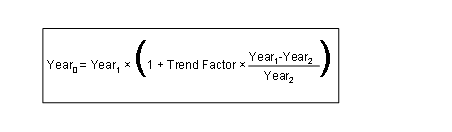
You have defined the trend factor in the forecast profile on the
Model Parameter
tab page in the
Annual Weighting Factor for Seasonal Trend Model with FPG
parameter. This defines the weighting of the relative changes during the previous year in order to determine the changes during the next year.
Year 1 is the current year, year 2 is the previous year.
If there is an available demand history over three years and the demand did not sequentially increase or decrease, the system calculates the demand for the next year as a weighted average.
If the planning costs for a product lie under the
Cost Limit for Demand in Seasonal Trend Model with FPG
parameter on the
Model Parameter
tab page in the forecast profile, or if the demand in year2decreased and then increased in year1, the system determines the demand for year0as at least the demand of the current year. If the planning costs lie above the
Cost Limit for Demand in Seasonal Trend Model with FPG
parameter, the system determines the demand for year
0 as at most the demand for the current year.
The system calculates seasonal factors S(i) according to the following formula:

x i and x i+12 are the demands for the period i of year 1 and year 2.
Using the total demand for the next year and the seasonal factors, the system forecasts the demand for each of the next twelve periods using the following formula:

The system calculates the mean absolute deviation (MAD) for the next twelve periods using the following formula:
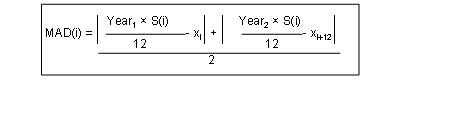
For each period i = 1 … 12
The system limits the MAD demand to a minimum percentage of the forecast demand. You can define this minimum percentage in the forecast profile on the
Initialization
tab page in the
Parameter for Determination of MAD Lower Limit
.
The system calculates the standard deviation by multiplying the MAD by 1.25.
The system pushes the time window of the first 24 periods one period forward, and then calculates the demand as described above. The demand calculation results in the forecast for the next periods that you have defined in the forecast profile on the
General
tab page in the
Forecast Periods
parameter. The system uses this calculation to calculate the ex-post forecast.
The system continues to push the time window forward by one period, calculate the demand, and calculate the ex-post forecast until it arrives at the current period. At this point the ex-post forecast then goes over into the actual forecast.