 Defining Available Capacity
Use
To determine and calculate the available capacity of a line, the system reads the line resource data relevant to scheduling.
For periods planned with period-based procedures, the system calculates a
capacity split
for each period.
For periods planned with sequence-based procedures, the system calculates a
takt split
for each period. Using this takt split, the system calculates the maximum number of products which can be produced on the line per shift or per day.
Prerequisites
You must maintain the line resource data relevant to scheduling. See also: Defining Line Resource Data Relevant to Scheduling
Features
Creating a Capacity Split
If planning uses a period-based procedure and is to create either shift or daily packages, it is not necessary to calculate an exact takt split as all orders are dispatched to the start of the shift or day. Therefore, the system only determines a simple capacity split with the net operating time of the line resource according to the following formula:
Available capacity = (gross time – breaks) x rate of resource utilization / rate
Creating a Takt Split
If planning uses a sequence-based procedure and is to dispatch orders with lot size 1, the system has to determine an exaxt takt split to be able to calculate the exact start time for each order.
Operating Time of a Line Resource
To determine the working time of the line, the system proceeds as follows:
If you change the capacity profile manually, the system calculates the operating time using the specifications in the capacity profile.
If you do not change the capacity profile, the system checks whether a capacity variant exists and uses this data.
If you have not defined an active capacity variant, the system uses the standard capacity you defined in the
Standard Capacity
tab page.
Scheduling Breaks
You can define fixed breaks using a break pattern in the capacity variant . These break times are then recognized as line downtime when calculating the operating time.
This is clarified in following example:
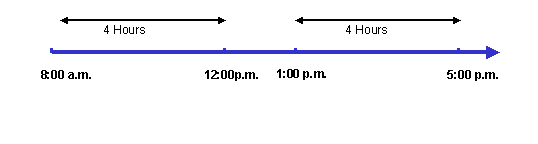
The shift starts at 8.00 a.m. and ends at 5.00 p.m. The time from 12.00 p.m. to 1.00 p.m. is defined as a fixed break in the capacity variant. This means the operating time is 8 hours. With a takt time of 1 hour, this results in a maximum production quantity of 8 pieces.
However, you can also define
variable breaks in the capacity profile
in the
Break Duration
field. If you define breaks using this option, the break duration is not calculated. Instead, the system increases the takt time.
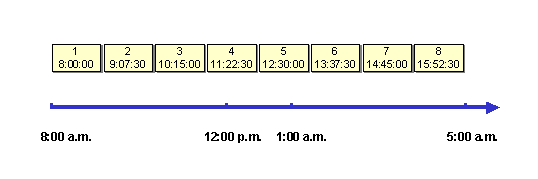
In the following example, the same shift is used as above (from 8.00 a.m. to 5.00 p.m.). A break duration of one hour is also recorded in the capacity profile. The takt time is one hour. The line works 8 hours and can therefore produce 8 pieces.
In this case, Model Mix Planning uses an operating time of 9 hours as the break is not taken into account. As a result, the takt time is increased to one hour and 7.5 minutes (9 hours / 8 pieces). This results in the following takt split. The individual times indicate when a piece is placed on the line.
Using a Rate of Resource Utilization
Using a rate of resource utilization or a shift factor increases or decreases the available operating time.
For example, if a line in a shift works 8 hours without a break and you have defined a rate of resource utilization of 110%, the operating time is increased to 8.8 hours.
Activities
APO proceeds as follows when determining the takt split:
Determining the operating time.
First, the APO determines whether to use the data from the
capacity profile
, theactive capacity variant
or thestandard available capacity
. APO then calculates the working time of the line using the available capacity.Determining the valid rate.
In the next step, APO checks whether a
rate model
with a valid production rate exists in the active capacity variant. If you have defined aproduction rate
it is used to calculate the takt time.If you have not defined a production rate, the system uses the base rate you maintained in the
Standard Capacity
tab page.Calculating the available capacity.
APO uses the rate to calculate how many pieces can be produced on the line in the available operating time. This quantity is the available capacity of the line.
Example
Early shift 6.00 a.m. to 2.00 p.m.
Fixed break: 12.00 p.m. to 1.00 p.m.
Rate of resource utilization in both shifts: 100%
Base rate = 3 pc per hour
Takt time = 20 mins
APO uses this data to calculate the following takt split: Each time indicates when a piece is placed on the line.
6.00 a.m. |
6.20 |
6.40 |
7.00 |
7.20 |
7.40 |
and so on... |
11.40 |
12.00 |
Break |
13.00 |
13.20 |
13.40 |
14.00 |
The available capacity is calculated as follows:
Available capacity in the early shift = 6 x 3 pieces (a.m.) + 1 x 3 pieces (after the break) = 21 pieces