

 Amortization According to LAC and SAC
Use
The key date value of your bond positions is calculated using amortization.
You can use the following two methods:
The LAC calculation assumes that the positions have a constant annual amortization rate.
The SAC method assumes an exponential amortization rate for the change in value of the positions. It calculates the net present value of the position for the key date by discounting the flows that arise from this position after the key date.
The positions are amortized:
There are two exceptions to this rule in the operative valuation area:
The amortization calculations are performed in the position currency. The results of the calculations (that is, the individual amortizations) are translated into the local currency or valuation currency using the acquisition exchange rate.
Prerequisites
Linear Amortized Cost (LAC)
You can use the following LAC position management procedures:
Scientific Amortized Cost (SAC)
You can use the following SAC position maintenance procedures:

Position management procedures for LAC and SAC are both available using gross and net methods. These two methods differ in the way they deal with premiums and discounts. Exception: SAC net incremental - there is no gross procedure for this
The net position management procedures do not manage premiums or discounts.
The gross position management procedures do manage premiums and discounts. Among other things, they can be used to depict borrower's note loans in the securities module.
See also:
The documentation on position management procedures in the Implementation Guide under Assign Position Management Procedure.
Features
Linear Amortized Cost (LAC)
The LAC amortization method values an item at 100% assuming a constant annual amortization of the book price.
(applies to position management procedures LAC net, LAC gross, LAC valuation (to the day))

whereby:
La = Duration in days between the last amortization and the current one
Lb = Duration in days between the last amortization and final repayment
(applies to position management procedures LAC net, LAC gross, LAC valuation (to the day))
whereby:
La = Duration in days between the last amortization and the current one
Lb = Duration in days between the last amortization and final repayment
(applies to position management procedure LAC valuation (to the year))

whereby:
Remaining term |
= the amount of time (in years) between the valuation key date and the final due date. |
You cannot write-down an item more than once in one year when you use the LAC method. If you have performed a LAC valuation for an item more than once in one year, you must reverse the write-up and write-down amounts.
If the old book price is over 100%, the system checks to see if there is a drawing date or a notice date. If such a date exists, it is chosen as the final due date.
Scientific Amortized Cost (SAC)
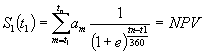
whereby:
a |
= flows relevant for effective interest rate from time t1 |
e |
= Effective interest rate calculated |



Scientific Amortized Cost (SAC) [SAC net incremental]
If the position management procedure SAC net incremental has been assigned to a position, then amortization takes place according to SAC as follows:
You can only perform the amortization once for each key date using the valuation function.
Calculation
whereby:
a |
= Repayment flows as from date T* |
e |
= Effective interest rate calculated |
See also:
AmortizationActivities
To carry out amortization according to LAC and SAC, choose Securities ® Accounting ® Operative Valuation Area ® Key Date Valuation® Execute Amortization.