

 Scenario - Importing to a Member Country of a Customs Union
Purpose
This scenario describes the processes involved in importing goods into a country that is a member of a customs union. (See Trade within a Customs Union in
The Situation Within Your Own Country)
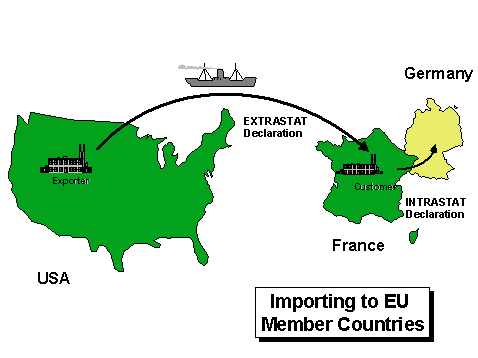
As an example, we discuss importing merchandise from the USA into France, a member country of the European Union (EU).
Considerations
Preferential Treatment
If the products or a part of the products you import qualify as originating in your country, they may qualify for preference. When you import goods that qualify for preference, you pay little or no customs duties.
For example, if your company is located in the European Union and you exported raw or semi-finished materials to be used for manufacturing products in another country and those materials are returned to your country, they may qualify for preference when you import them. Therefore, you may not have to pay customs duties on such goods.
In the SAP System, preference determination is a 2-step process - the first step determines whether a product is authorized for preference handling - the second step calculates the actual preference price.
General System of Preferences
The EU’s general system of preferences (GSP) for developing countries boosts the development of trade and is based on trade concessions granted autonomously by industrialized nations.
The GSP permits Latin American and Asian countries to export goods to the European Union at lower than normal duty rates for manufactured goods and processed agricultural products. This program is also offered to promote the ideals of the European Union in the developing world.
See also:
 Preference
EXTRASTAT declarations
The extra-European Union trade statistics (EXTRASTAT) declaration for imports and exports is a monthly declaration that provides EU authorities with statistics on trade between EU member states and non-EU countries (for example, trade between Italy and Brazil).
This declaration helps keep track of commodities that are transferred into or out of the European Union. (See
Periodic Declarations and
Creation of Periodic Declarations).
Import Process
More than one scenario is possible for this import process depending upon the disposition of goods once they arrive in a customs union. As examples in the scenarios below, we use the import of goods from the USA to France. In Scenarios II and III below, the process explains what must be done to transfer the same merchandise as domestic goods from France on to Germany (Scenario II) or in-bond as foreign goods from France to Germany (Scenario III).
Scenario I – Import from a Third Country to an EU Member State
The USA is an independent third country with which France – a member of a customs union – has no trade agreement. In this scenario, company F, in France, imports goods from the USA and keeps them in a warehouse for sale at a later date.
Scenario II – Import to an EU Member State for Subsequent Dispatch to Another EU Member Country
In this scenario, Company F, in France, imports merchandise from the USA for sale to Company G, in Germany.
Scenario III – Import to an EU Member State with Forwarding to Another EU Member Country "In-Bond" (Duty Unpaid)
In this scenario, Company F, in France, imports computer hardware from the USA for sale to Company G, in Germany, but does not process the foreign (non-domestic) goods in France through customs. Instead, the goods are forwarded in-bond, duty unpaid, to the receiving country. Prior to shipping the foreign merchandise, the goods may be kept for a period of time in a
foreign trade zone or a bonded warehouse.
The T1 document is used as a declaration for transporting non-domestic goods between two locations (in-bond) within the EU customs territory. This applies not only to two countries within the EU, but also between a port and an inland city where the customs procedures will be completed (for example, to transport goods from the port in Hamburg, Germany, to Frankfurt). Since customs inspections may take place anywhere along the route, the T1 document must always accompany the goods.
See also:
Single Administrative Document for Europe (FEEX)
Goods Movement Certificate EUR.1 for Europe (FEEU)
T2 Document for Europe (FET2)
T5 Document for Europe (FET5)