

 Scenario - Importing from a Third Country
Purpose
Purpose
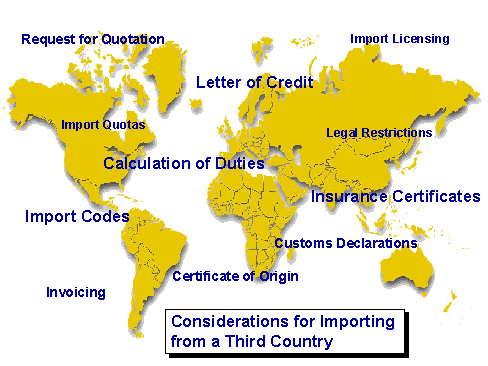
This scenario describes the processes involved in importing goods into your country from a third country. In this sense, a "third country" is defined as the country of export when no trade agreement exists between your country and the exporter. In this case, you are responsible for compliance with the import laws of your own country.
Reasons for Importing Goods
There are three primary reasons for importing goods.
Trade
There are three main reasons why you may want to import for trade purposes:
Production
It is sometimes advantageous to import raw or semi-finished materials to be used in a manufacturing process.
Transit
Foreign merchandise with the status "in transit" is exactly that – passing through your country on the way to another. At the plant level in the SAP System, this refers to a goods receipt that immediately becomes a goods issue to a country other than the location of your plant. A carnet TIR (document which allows passage of foreign merchandise through a customs territory) may be required for the transfer of goods under bond in your country.
Prerequisites and Considerations
Duty Payment Requirements
For production and trade purposes, duties may or may not be assessed for goods entering your country. As a rule, no duties are assessed for goods in transit within your country.
Import Quotas
Quotas are sometimes imposed on imported merchandise to protect the local market. Once the quota has been reached or exceeded, the tariff duty rate may be increased or the merchandise may be held in a foreign trade zone or bonded warehouse until the absolute quota is again available. This waiting period may be as long as a year. Therefore, importers should ascertain in advance whether an absolute or tariff rate quota exists on the import goods.
Commodity Codes and Calculation of Duties
Before you can calculate the duties that must be paid on your imported goods, you must correctly classify the product based on its
commodity code or import code number (the first six digits are always the same internationally). These codes are found in the Harmonized Commodity Description and Coding System (usually known as the HS or Harmonized System). Once you have determined the code for the goods, you can determine the rate of duty in the harmonized tariff schedule. Tariff schedule rates differ for each country and, in cases involving a quota, these rates are usually higher once the quota has been reached.See also:
 Loading of Commodity Codes and Import Code Numbers
Import Process
The import process illustrated and described below answers the following questions:
For information about the process of importing merchandise involving a letter of credit, see
Scenario - Import Involving a Letter of Credit.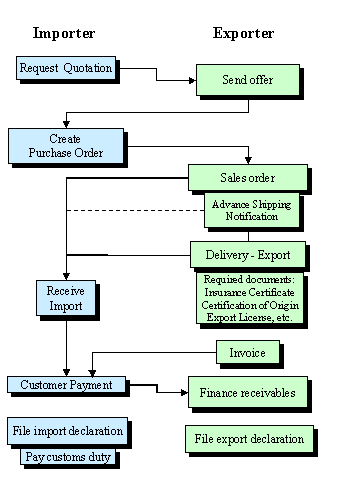

You can create the documents mentioned above (other than insurance certificates) using the SAP FT application.
Import licensing is generally only necessary for drugs, weapons and alcoholic beverages. Special licensing may be required for countries with trade restrictions. If needed, you can obtain these licenses from the corresponding regulatory agencies of the state or federal government.
create the customs declaration for the import.
See also:
US Customs Entry Process