

 Sensitivity Key Figures
Use
The risk of a fixed interest security (disregarding the creditworthiness of the debtor and market efficiency) consists in any change to the market interest rate during its term (interest rate risk). The interest rate risk can be split into two components: rate risk and reinvestment risk.
All repayment flows (principal repayments, interest and compound interest) for an investment that occur before the investor’s planning horizon, are exposed to reinvestment risk. For example, if market interest rates are falling, the coupon payments can only be reinvested at lower interest rates. If the maturity date of the investment exceeds the planning horizon, then there is an additional rate risk because the rate is determined during the term by the market interest rate.
Market interest rate changes have opposite effects on both these yield components of an investment: increasing interest rates give rise to rate losses on the one hand but increasing reinvestment yields on the other. Sensitivity key figures enable you to quantify and manage such interest rate change risks and opportunities more simply.
Scope of Functions
You are able to calculate the following traditional sensitivity key figures:
Macaulay duration describes the term of an investment needed for the counteracting effects of rate change and reinvestment yield to offset each other exactly. Using this point in time as the planning horizon, the investor is then immune from any interest rate changes. Macauley duration is calculated using the following formula:
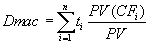
PV = Present value
CFi = Cashflow at time point i
The Macaulay duration for a portfolio is calculated as the average of the individual Macaulay durations of the single transactions. This average is weighted by the net present values.
Modified duration indicates the percentage change to the value of an interest instrument when the interest level changes by one percentage point. Hence it describes the elasticity of the NPV to interest rate changes. Modified duration corresponds to the quotient from Macaulay duration and (1+r) and is derived using the following formula:
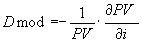
This is calculated using the mean value from the difference quotient (shifted positively and negatively) of the net present values. This is an approximation used for the derivation (see also

Convexity describes the sensitivity of the NPV to the square of the yield change (description of the shape of the price curve). Therefore this is more accurate than modified duration and is calculated as follows:
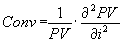
The SAP System uses the following approximation formula for the convexity:


The key figures Macaulay duration, modified duration and convexity are not calculated for options products as this is not helpful from a business point of view.
The basis point value indicates the market value change in the event of an increase in market interest rates for all terms, each by one basis point (0.01%). Absolute changes are described here.


Activities
You have two options for calculating sensitivity key figures. Either use the functions in the
 results database or choose Accounting ®
Bank Applications ®
Risk Analysis ®
Market Risk Analysis ®
Information System ®
Sensitivity Key Figures.
results database or choose Accounting ®
Bank Applications ®
Risk Analysis ®
Market Risk Analysis ®
Information System ®
Sensitivity Key Figures.
Effect of Yield Curve Settings on Macauley Duration, Modified Duration and Convexity
the following applies:
Macauley duration = term of the cash flow.
Modified duration = term / (1+ interest rate x term) = Macauley duration / (1+ interest rate x term)
Convexity = 2 x (term) ^ 2 / (1 + interest rate x term) ^ 2
the following applies:
Macauley duration = term of the cash flow.
Modified duration = term / (1+ interest rate) = Macauley duration / (1+ interest rate)
Convexity = term x (term + 1 year) / (1 + interest rate) ^ 2
the following applies for all due dates:
Macauley duration = term of the cash flow
Modified duration = term = Macauley duration
Convexity = (term) ^ 2
In other words:
If you compare the yield curve settings with and without continuous compounding, you find that the convexity, where the term is less than one year and there is no continuous compounding, is approximately twice the value as when continuous compounding is used. Where the term is larger than one year, there is a point in time from which the convexities with continuous compounding are larger than those where continuous compounding is not used.
When continuous compounding is used, modified duration and Macauley duration are the same. When continuous compounding is not used, they are different.
This behavior is due to the different properties of the interest rates in the three maturities shown above: