

 Interpolation
Use
Interpolation uses existing interest rates to determine a value for an interest term of a yield curve for which no interest rate exists. Interpolation is used in the following cases:

Annual grid values, meaning grid points such as 1 year, 2 years, that are not defined as reference interest rates (grid points) of the yield curve are needed for the calculation of the zero bond discounting factors.
For the yield category par rate, the interest rate specified in the basis used for interpolation is interpolated for the date for which the system is looking for an interest rate. It is interpolated according to the interpolation procedure defined for the yield curve type and calculated from the interpolated par rate of the zero coupon and the zero bond discounting factor. For the yield category zero bond yield, first the interest rate specified in the basis for interpolation is interpolated according to the interpolation procedure, and from this the zero bond discounting factor is then calculated. In this case the par rate is not calculated (unless continuous compounding zero interpolation is specified).
If continuous compounding zero interpolation is active, zero bond rates are calculated from the zero bond discounting factors using continuous compounding and the interest calculation method act/365. This applies to all yield types. The equivalent yield curve calculated without continuous compounding is used as the initial yield curve. In other words, at the grid points, a yield curve with continuous compounding zero interpolation is identical to the equivalent yield curve without continuous compounding. It is always linear interpolation that is used to calculate the continuous compounding zero bond rates, irrespective of which interpolation procedure is applied. The units
zero bond discounting factors and forward rates describe how par rates and zero coupon rates are calculated (in the interest calculation method of the yield curve) from interpolated continuous compounding zero bond rates.Features
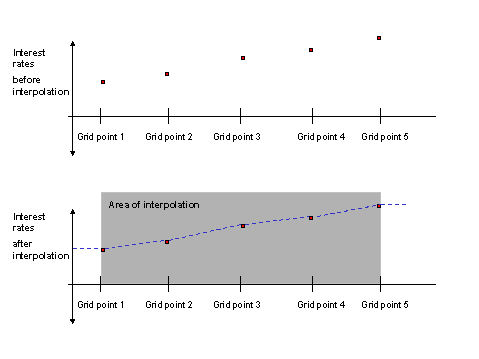
If the term of an interest rate that the system is looking for is before the first or after the last grid point, the first or the last grid point is used (extrapolation). If the system is looking for an interest date that is between two grid points of the yield curve, either linear interpolation or cubic spline interpolation is used, depending on the interpolation parameter of the yield curve type:
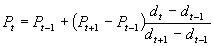
The values are interpolated as follows:
Pt: interpolated interest rate at time t
Pt-1: lower grid value at time t-1
Pt+1: upper grid value at time t+1
dt : term of the required interest rate in days
dt-1 : term of the lower grid value in days
dt+1: term of the upper grid value in days
The cubic spline interpolation procedure uses parts of third degree polynomials that are linked to the grid points by suitable conditions in such a way that the yield curve is continuously differentiable. Unlike the linear interpolation, in cubic spline interpolation all grid points are included in the calculation of an interpolated value.
Cubic spline interpolation provides better interpolation values than linear interpolation. This means, however, that cubic spline interpolation is more complex, more extensive and, therefore takes longer to run than linear interpolation.

In the graphical depiction of the yield curve, the grid points are linked in a linear way irrespective of the interpolation category of the yield curve. This means it is not possible to display a graph of cubic spline interpolation.
Example
Interest rates of the grid values:
|
Days |
Grid values |
|
1 |
5.0% |
|
30 |
5.3% |
|
90 |
5.6% |
|
365 |
6.0% |
|
1096 |
6.4% |
Validity date: 04/01/1994
Interest calculation method: act/360
Interpolated annual grid value for the term of 2 years (731 days):

P731 = 0.062503419