

 Zero Bond Discounting Factors
Use
The zero bond discounting factors (ZBDFs) are used, among other things, for the following purposes:
You use zero bond discounting factors especially when the yield curve is not flat. The ZBDFs are determined from interest rates sequentially, meaning from the cumulated ZBDFs of the previous years. The matched maturities-valuation of a cash flow requires duplication of the cash flow course of a financial instrument (specified by the payment amount and time) using various other financial instruments.
Zero coupon bonds, for example, can be used as duplication financial instruments as their use avoids the reinvestment problems of return flows. The classic effective interest methods work on the assumption that the cash return flows are reinvested at the effective interest rate, though this is only realistic if the course of the yield curve is horizontal. The use of yields from zero coupon bonds or the zero coupon structure curve (yields - zero bonds = f (term)) relates directly to the current interest structure.
Calculation is as follows:
Terms in days in accordance with the chosen interest calculation method
jt : days in the year of year t in accordance with the interest calculation method
bt : annual
base days of the term of the ZBDFt in accordance with the interest calculation method
ZBDFcumulated : cumulated ZBDF of the previous
annual grid values

Pt: interest rate for the term of the required zero bond discounting factor
dt : term of the required zero bond discounting factor
dt-1 : term of the previous
annual grid value
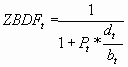 where dt
£ 1 year
where dt
£ 1 year
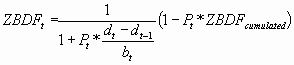 where dt > 1 year
If continuous compounding is active, the zero bond discounting factor ZBDF is calculated using the continuous zero rate zcc (time entered in ACT/365):
 .
.
Example
Example for Zero Bond Discounting Factors