

 Position Management in the Operative Valuation Area
Several different position management methods are supported in the Securities area. These position management methods are closely linked to valuation, since the valuation category and a few additional indicators are used to represent these methods in the system.
Within a position-management unit, the positions of any one class are considered as one position, even if they are held in different securities accounts. This means that when you purchase a class in one position-management unit, the system generates adjustment flows as planned records for the acquisition/book value, and thus calculates an average acquisition/book price for all securities positions of the class in the position-management unit. When you make a sale, the realized
price gains and losses are calculated and generated as planned records. When you perform period-end closing, you close a period for position changes in the position-management unit, and transform the planned records into actual records.Position-management units usually correspond to the valuation groups. In other words, you valuate your positions for the position-management units.
The following section describes the position-management and valuation methods available and shows you how they are represented in the system:
To manage your positions for all securities accounts, you form a position-management unit by grouping together all the positions of one class, within a company code, that are held in different securities accounts. There are two methods of forming these position-management units that handle all securities accounts.
You can use either method within a company code, but not both at the same time.
With this type of position management, the positions of a class in different securities accounts are grouped to form securities account groups (= position-management units). You can form individual securities account groups for each class.
The positions form a position-management unit in which the company code, the class and the securities account group are the same.
Example: Securities Account Groups
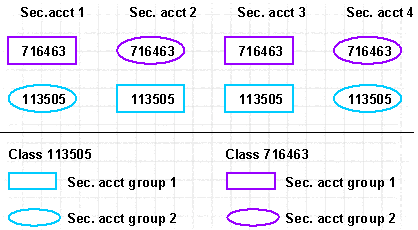
To manage your positions at securities account group level, you select a valuation class with valuation category 20.
You determine which securities account group a position is assigned to using the securities account position indicator. When you purchase a class for a securities account for the first time, you must assign this position to a securities account group in the

Portfolio valuation must not be activated if the following conditions apply:
- the system is a productive system in operation and
- valuation classes exist with valuation category ‘20’ or ‘22’ and
- these valuation classes have been used in at least one position indicator and
- posted flows already exist for this class, or flows (planned records) have yet to be posted.
To manage your positions for specific securities accounts, you group together all positions of a class in one securities account to form a position-management unit.
Example: Position management for a specific securities account
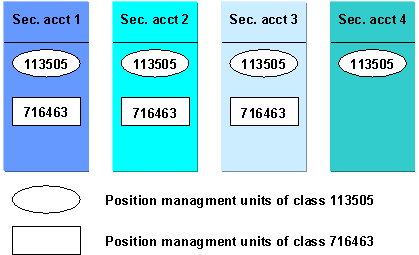
To manage your positions for a specific securities account, select a valuation class with valuation category 21.
If you also flag the portfolio indicator, you can only use these portfolios for evaluation purposes. You still manage your positions for specific securities accounts.
With single position management, the position-management unit is defined by a position inflow (purchase, inflow from a securities account transfer). The position includes all flows that are assigned to the inflow.
You conduct single position management using a valuation class with valuation category 10.
In the money market, foreign exchange and derivatives areas, valuation category 10 is the only permitted valuation category.
In the securities area, you can only use valuation category 10 for zero bonds.
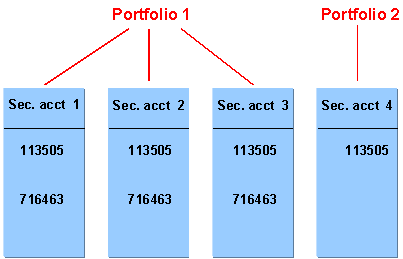
Valuation category 22 enables you to manage your positions at securities account level at the same time as valuating them for all securities accounts. Valuation takes place at either portfolio level or at securities account group level depending on whether or not you have set the portfolio indicator. In day-to-day business, you determine the price gains for each securities account.
Therefore, all the positions in a securities account that belong to the same class make up a position-management unit. Valuation groups, however, are made up of all the positions of one class in a securities account group or a portfolio.
In order to manage positions according to this principle, you assign them a valuation class with valuation category 22.
Depending on whether or not you want to valuate your positions at portfolio level or at securities account group level, flag the portfolio indicator in Customizing for Securities by choosing Assign Company Code.
Summary
The following table summarizes the system settings for the different position management methods.
Overview table for position management
Valuation category |
Portfolio indicator |
Position management |
10 |
without |
Single position management |
10 |
with |
Single position management, portfolios are for evaluation purposes only |
20 |
without |
At level of securities account groups |
20 |
with |
At portfolio level |
21 |
without |
At securities account level |
21 |
with |
At securities account level, portfolios are for evaluation purposes only |
22 |
without |
At securities account level, with simultaneous valuation at securities account group level |
22 |
with |
At securities account level, with simultaneous valuation at portfolio level |
See also:
Valuation