 The Arrangement of R/3 Organizational Units Displayed
The Arrangement of R/3 Organizational Units Displayed
Definition
There is a predefined order for stacking the tiles of a structure scenario. This order is partly due to R/3 business rules, in other words, the order is a result of the dependencies that hold between the various R/3 system organizational units, and partly due to convention. Model the R/3 system organizational units in this defined order.
R/3 Organizational Units within the System Infrastructure
The physical R/3 System and the logical system (client) are the same across the applications.
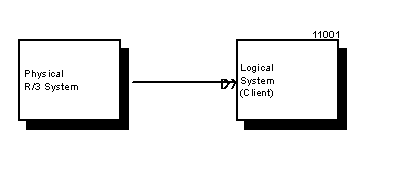
All R/3 System organizational units described in this section are dependent on the client (the logical system), which depends in turn on the physical R/3 System For clarity, the directed relationships are not shown in the following sections.
In the following section the organizational units are combined into groups and an overview of the dependencies that exist between them is depicted. The section is from the SAP Enterprise Data Model, which shows selected dependencies. More information on relationships between organizational units can be found in the SAP Enterprise Data Model and in the Business Object Repository.
The R/3-System Client (logical system)
Selected Organizational units for Accounting
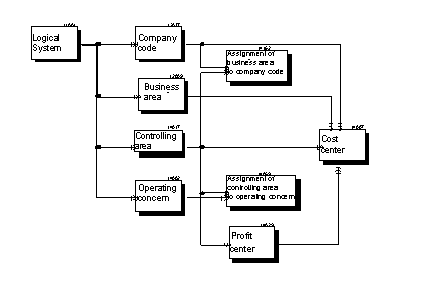
Operating concern Controlling area Controlling area Business area Profit center Cost center
Selected Organizational units for Consolidation

Consolidation unit Consolidated entry
Selected Organizational units for Logistics

Plant Purchasing organization Division Distribution channel Sales organization Sales area
In the Structure Modeler selected R/3 system organizational units have their own shapes. The Structure Modeler also includes a "dummy organizational unit" that can be used for any other organization unit.
.There are plans to increase the number of available shapes for organizational units in the Structure Modeler. In particular, organizational units that often take on strategic importance in an enterprise-specific context will be considered.
A list of R/3 organizational units can be found in the SAP Enterprise Data Model and in the Business Object Repository.