

Use
As a rule, appropriation requests are subject to an approval process. This approval process usually involves a number of persons, as well as organizational units, within your enterprise.
Features
You can therefore design the approval process to meet your specific needs. You use SAP R/3 status management and Workflow functions.
For more information on the approval process, see
Approval of Appropriation Requests.Prerequisites
In order to use the automatic approval process, you have to activate the approval workflow for appropriation requests in Customizing for Investment Management (Approval
® Activate Event-Linkage for Workflow Tasks).
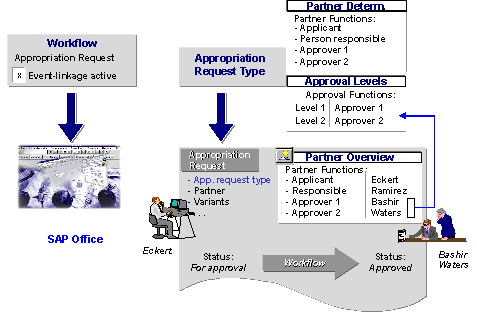
System Settings for the Approval Process
You have to assign partner functions, which are responsible for approval, to the individual approval levels. You define the partner functions in the partner determination procedure in the appropriation request type (refer to
Partner Management). You have to specify the persons, who fulfill the partner functions, in the master data of the appropriation request.You define the required approval levels for each appropriation request type. You have to go through the approval levels sequentially in the correct order, until your appropriation request is approved or rejected. As soon as the appropriation request is rejected on one approval level, the entire appropriation request is rejected.

Only one person can be entered directly for each partner function in the approval process. However, the system determines the person for the partner function indirectly, if you use partner functions that do not have a "system user" partner type. For example, if you use partner type "position", the system determines the person who occupies the position, and enters that person for the partner function. But it is possible that the more than one person occupies the position. In that case, it is possible to have more than one person fill the partner function. The appropriation request is approved as soon as one of these persons gives his or her approval. For more information on partner types, see