Progress Analysis Process
Progress Analysis Process
Purpose
You use progress analysis to obtain information on the state of your project and how it is developing. This enables you to take corrective action if the project is varying from its plan.
In the Project System, deliverables are generally planned in activities. This means that project progress should be determined at activity level.
You can use the planned costs or the budget or the planned POC determined by the system to represent the planned services in Project System reports.
Progress analysis supplies current data at all times while the project is running. For more information, see
Progress Analysis .Process Flow
To enter data for progress analysis during the execution of your project, proceed as follows:
If you do not define a measurement method, the system determines the valid one automatically - for example, from the default value you have defined in customizing for the object.
See Determining the Measurement Method .
Note that progress analysis only considers costs planned by cost element.
As part of this, the system:
In the information system you can analyze the progress data, together with other project key figures. This gives you an overview of how your project has progressed over time, both planned and actual.
See
Result
Progress analysis supplies you with precise information on the state of your project, and the cost and schedule situation. You can recognize trends independently of the costs planned and posted in CO, and can take appropriate action.
Example
The following example illustrates the importance of progress analysis for valuing your project’s progress and the resulting schedule and cost variances.
Progress Analysis Versus Plan/Actual Comparison
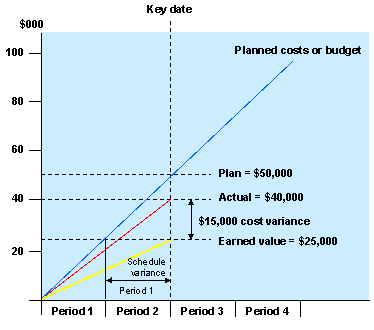
You expect a customer project to incur costs of $100,000. The project lasts four periods. The planned costs are distributed evenly over these periods ($25,000 per period). Total actual costs posted for periods 1 and 2 are $40,000.
The graphic below illustrates the plan/actual comparison, showing a favorable project situation. The project costs seem likely to be less than the planned costs.

If you now look at the work actually done, the situation appears different.
In period 2, you run a progress analysis. The system determines the actual POC as follows: With overall planned costs of $100,000, the BCWP is $25,000 (overall planned costs * POC). As the actual costs at this point amount to $40,000, the BCWS is also $40,000, meaning that there is a cost variance of $15,000. In addition to the cost variance, the report shows that there is a time variance. The earned value of $25,000 should have been reached at the end of period 1. This means that the project is one period behind schedule.