 Financing from the Organization Component
Financing from the Organization Component
Purpose
This process describes how you can finance employees in your organization using the budgets of budget structure elements.
The financing process is closely linked to the
Budget Allocation process (since both processes supply budget funds to cover personnel expenditures).However, in the Financing process, budget funds are made supplied using a position or person as the point of departure, whereas the budget of a budget structure element is the point of departure in the Budget Allocation process.
Basically, there are two ways of financing an employee in the organizational structure:
The budget structure elements in HR Funds and Position Management correspond to a combination of fund, funds center and commitment item in an FM area (Funds Management account assignment) in Funds Management.
If you allocate the budget of a budget structure element for the purpose of financing a person or position, the system determines the financing required for the object you are trying to finance, and creates a funds reservation for the corresponding Funds Management account assignment.
The table below shows the various ways in which the system can determine the financing required. In Customizing, you can determine how the financing required should be determined.
Financing Object |
Determine Financing Required Using | |
Default Value |
Payroll Simulation | |
Person |
X |
X |
Staffed position |
X |
X |
Unstaffed position |
X |
|
If you finance an employee directly using the budget of a budget structure element, you supply funds to cover the personnel expenditures incurred by this employee. This type of financing is referred to as direct financing because funds are assigned directly to the employee (and not via a position). This means that you can finance employees who are not assigned to positions. Direct financing creates a funds commitment in Funds Management. This commitment is offset by the payroll accounting postings.

You have hired a temporary worker for 6 months. This worker is not assigned to a specific position. By financing the employee directly (in the

If you finance employees indirectly, you assign funds from the budget of a budget structure element to a position, and in this way cover the personnel expenditures incurred by the employees assigned to the position in question. This type of financing is referred to as indirect financing because funds are assigned via positions (and not directly to employees). Indirect financing creates a fund precommitment in Funds Management. If this position is subsequently staffed, and if the holder of the position is financed via the position, the precommitment is converted into a commitment for the employee in question. The amount of the precommitment is calculated on the basis of the default pay scale values defined for the position. The commitment, on the other hand, is calculated on the basis of the person’s actual pay.
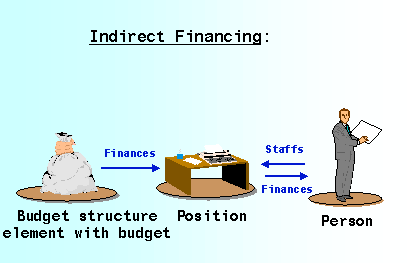
You can also use indirect financing to reserve funds for positions that have not yet been staffed.
You can combine both types of financing as you please (in other words, you can finance a portion of the personnel costs incurred by an employee directly, and a portion indirectly).

If you have already defined a financing assignment, and you want to change/supplement this, you can only use budgets of budget structure elements with the same budget unit as the object that already provides financing.
When you supply the funds required for an employee (i.e. finance the employee), the employee’s absences (infotype 2001) are also taken into account. This means, for example, that no financing is required for an employee who has taken unpaid leave. In Customizing, you can define how absences are to be handled in HR Funds and Position Management.
Prerequisites
Depending on the circumstances in your organization, you must have defined a budget hierarchy with budget structure elements and budgets, an organizational structure with positions, and relationships between positions and persons. You can only finance objects with the budgets of allocatable budget structure elements (i.e. the budget structure elements in question must not be summarization items).
In Customizing (step: Overall Budget ®
Settings for Financing Persons/Positions ® Define Financing Types for Each Object Type), you must also have specified which types of financing (monetary values and FTEs) are allowed for positions and persons. Furthermore, you must have defined how the employee’s absences (infotype 2001) affect financing (step: Overall Budget ® Settings for Financing Persons/Positions ® Define How Absences Are Handled).You must also have specified how the financing required for specific employee groupings is to be determined (step: Overall Budget ® Settings for Financing Persons/Positions ® Determining Financing Requirements).
Finally, you must have made all the necessary settings in the Integration section of Customizing for HR Funds and Position Management.
If you want to finance positions in HR Funds and Position Management, you must have defined a company code for these positions or for their superior organizational units in the Account Assignment Details infotype (1008) in the Organizational Management component.
If you have restricted integration between HR Funds and Position Management and Funds Management to specific employee groups and subgroups (see Customizing), then you must have assigned the appropriate employee groups and subgroups in the Employee Group/Subgroup infotype (1013) of the positions that are to be involved in integration.
Process Flow
See also:
Financing Employees Directly from the Organization ComponentFinancing Employees Indirectly from the Organization Component
Mass Finance Tool Financing Employees Directly in the Employee Component Financing Employees Indirectly in the Employee Component Financing Wizard Deleting Existing Financing Assignments Reconciling the Outgoing Funds of a Position That Has Been Financed Financing Overview Display: Financing Details in the Organizational Structure Payroll Accounting and Data Transfer