 Configuration Time
At configuration time you implement the Exchange Infrastructure in such a way that you can transform the business processes designed at design time at runtime. This is normally the task of consultants and administrators, while developers make settings just for test purposes. To be able to use the following services of the Integration Server, they must be configured first:
· Logical routing, in other words identifying the receiver business system and the receiver interface
· Technical routing, in other words determining the technical system address for the logical receiver business system and
· optionally, executing a mapping
The following graphic provides you with an overview of the execution of these services on the Integration Server, and the information they require from the Integration Directory:

Only the most essential services are shown to keep the graphic simple. Also, the graphic only returns the logical process flow of message processing. Therefore, the directory data is not read directly from the Integration Directory, but from a cache, for example.
Logical View of Message Processing
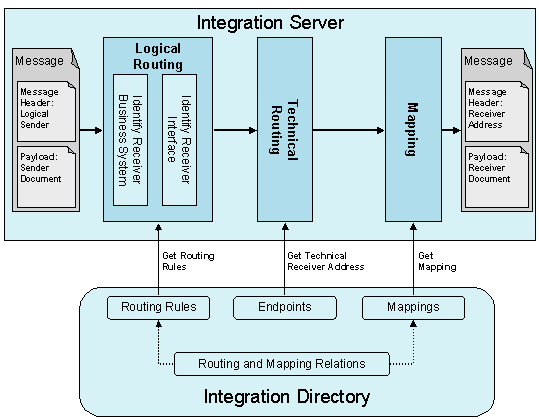
Using the data from the Integration Repository as a foundation, you must configure the following content to be able to use these services:
· The routing rules for receiver identification comprise the following:
¡ A routing relation that you use to assign a receiver business system to a sender business system and a sender interface. You can also use these relations to define additional rules that must be fulfilled for the message to be forwarded.
¡ A mapping relation that you use to assign a sender interface a receiver interface.
· Therefore, the mapping relation determines which sender interface belongs to which receiver interface. If a mapping is to be executed for this interface pair, you can select it from the repository and assign it to the mapping relation.
· You must create end points for technical routing through which the technical receiver of a message is defined (in the case of an SAP system this is an application server). The logical receiver (= business system) is linked to the technical receiver (for example, a system or a URL) using an end point.
To be able to define routing relations and end points, you must have already maintained the corresponding system data in the System Landscape Directory:
¡ The business systems for the communication partners and for the runtime components of SAP Exchange Infrastructure (for example, the Integration Server)
¡ The technical systems assigned to the business systems
By separating the two, it is easier to exchange the technical systems and separate the logical business process from the technical administration.
