 Group Logistics Scenario
You can use a group logistics company process to consolidate all the transportation requirements from all the companies in your enterprise into one central logistics company. Your core business activity can be something other than providing transportation services. For example, you have a group of companies that manufactures products. You need to transport the products to your customers. You can have one of the following business scenarios:
One company in your group of companies manufactures products and also plans and organizes transportation services for your other internal manufacturing companies.
One company in your group of companies does not manufacture product but instead is a dedicated group logistics company. All your manufacturing companies use the group logistics company for transportation services.
You can have a dedicated group logistics company for the following business reasons:
Lower transportation costs
A single dedicated logistics company can get cheaper transportation rates from a logistics service provider (LSP). For example, each individual company approaches an LSP separately. Each company gets a less than container load (LCL) rate from the LSP. However, if you approach an LSP as one company with one transportation requirement, you can get a full container load (FCL) rate.
Standardized logistics process
You have a standard shipment and tracking process across all companies. Resources are not duplicated across companies. For example, your manufacturing companies can concentrate fully on manufacturing.
Visibility
You can have full visibility to your transportation demands and execution from a centralized operation.
The figure below illustrates a business example of a group logistics scenario, where your companies share a single warehouse, and where an internal company manufactures product and also provides a transportation service to the other manufacturing companies in your group of companies. The graphic is followed by an explanation:
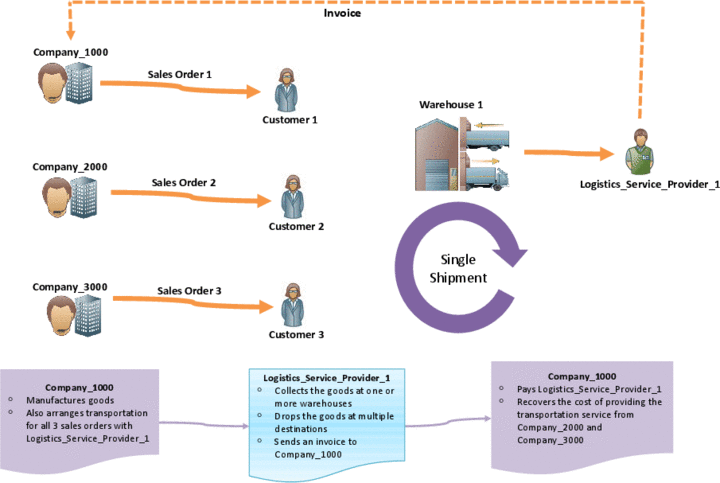
Company_1000, Company_2000, and Company_3000 belong to the same enterprise. Company_1000 manufactures product, but also provides a transportation service for Company_2000 and Company_3000.
Company_2000 and Company_3000 act as internal shipper companies, buying transportation services from Company_1000. Company_1000 acts as a forwarding house. It buys transportation services from Logistics_Service_Provider_1, and sells transportation services to Company_2000 and Company_3000.
SAP Transportation Management (SAP TM) creates an order-based transportation requirement (OTR) or delivery-based transportation requirement (DTR) for each of the sales orders or deliveries that each company has in place with their respective customers in SAP ERP. Company_1000 then creates a freight order for the OTRs or DTRs, with itself as the purchasing organization. It sends the freight order to Logistics_Service_Provider_1.
Logistics_Service_Provider_1 collects the cargo at the warehouse and delivers the cargo to multiple destinations. The destination locations are geographically close together. Logistics_Service_Provider_1 sends an invoice to Company_1000 for the freight order. Company_1000 pays Logistics_Service_Provider_1. Company_1000 uses the internal settlement process to recover the cost of providing the transportation service from Company_2000 and Company_3000.
Unlike in the standard transportation process for shippers, in a group logistics scenario, Company_1000 can create and transfer internal settlement documents when the life cycle status of the freight order is In Execution
.
More Information
Subject | See |
|---|---|
Detailed process flow for an group logistics company, including cost distribution | |
Comparison between the standard settlement process for shippers with the process for a group logistics company | Comparison: Standard Shipper Process and Group Log. Co. Process |