 Appointment
You can also define your own appointments in the freight order. These are time windows that you use to define when the delivery or pick-up at the customer is to take place. You can define start and end times.
If the carrier makes an appointment with a customer on your behalf and includes this in his or her tendering response, it is also displayed in the freight order.
The appointment is a hard constraint for scheduling. During scheduling the system compares the acceptable times and the requested times for the freight units with the appointment. If the acceptable times do not lie within the appointment, the system generates an error message.
The acceptable start time of loading and the acceptable end time of unloading are decisive factors here. These must lie within the appointment. If this is not the case, the system generates an error message. Note that the acceptable end time of loading and the acceptable start time of unloading can lie outside the appointment.
Activities
You can define appointments in the freight order on the Overview
and Stages
tab pages. To do this, double-click a transportation stop. In this case, a tab page for dates/times is displayed in the lower section where you can define your appointments.
Example
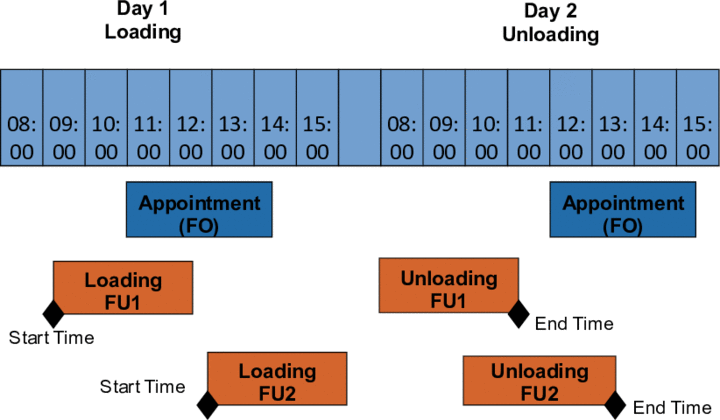
Appointments
For day 1, you have negotiated an appointment between 10:00 and 13:30 with your customer for the loading of a freight order (FO). For day 2, you have negotiated an appointment between 11:00 and 14:30 to unload the same freight order.
The acceptable start time for loading freight unit 1 (FU1) is earlier than the start time of the appointment for loading the freight order. As a result, the system generates an error message. The acceptable end time for unloading freight unit 1 also lies outside the appointment for unloading the freight order. The system also generates an error message for this.
The acceptable start time for loading freight unit 2 (FU2) lies within the appointment for loading the freight order. The acceptable end time for unloading also lies within the appointment for unloading the freight order.