 Examples of Compartments
Fixed Compartments
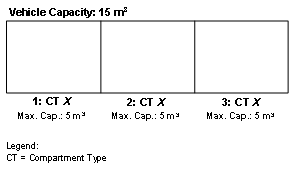
In this example, the vehicle resource comprises three compartments with the compartment type X. Each compartment has a maximum capacity of 5 m 3 . The total capacity of the vehicle resource is 15m 3 .
Flexible Compartments (Without Steps)
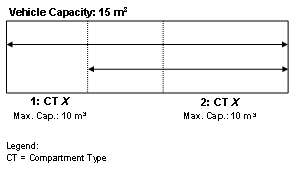
In this example, the vehicle resource comprises two compartments with the compartment type X. Each compartment has a maximum capacity of 10m 3 . The total capacity of the vehicle resource is 15m 3 , in other words, you are not allowed to load more than 15m 3 onto the vehicle resource.
Flexible Compartments (with Steps)
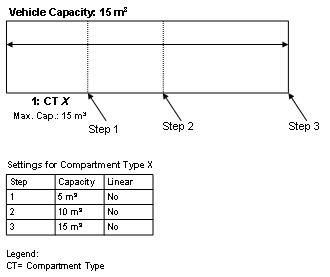
In this example, the vehicle resource comprises one compartment with the compartment type X. The compartment has a maximum capacity of 15 m 3 . The total capacity of the vehicle resource is 15m 3 . The compartment has three steps (5 m 3 , 10 m 3 , and 15m 3 ).
This means the following for the compartment:
Zero consumption is not possible for the compartment. That means if you do not load this compartment, it still consumes a capacity of 5m 3 .
Each load that is greater than or equal to 0 m 3 but less than or equal to 5m 3 results in a capacity consumption of 5m 3 . That means if you load this compartment with 3m 3 , for example, it still consumes a capacity of 5m 3 .
Each load that is greater than 5 m 3 but less than or equal to 10m 3 results in a capacity consumption of 10m 3 .
Each load that is greater than 10 m 3 but less than or equal to 15m 3 results in a capacity consumption of 15m 3 .
 Note
NoteIn a realistic scenario, you would define a second compartment, for example, a flexible compartment without steps.
End of the note.
Flexible Compartments (Zero Consumption Is Not Possible)
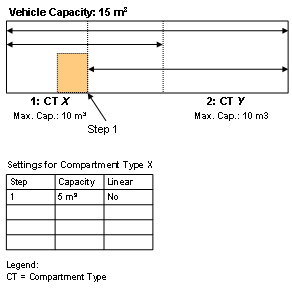
In this example, the vehicle resource comprises two compartments. Compartment 1 has compartment type X, compartment 2 has compartment type Y. Each compartment has a maximum capacity of 10m 3 . The total capacity of the vehicle resource is 15m 3 . Compartment 1 has a door and a step (5m 3 ). Compartment 2 does not have any steps.
This means the following for the two compartments:
Compartment 1:
Zero consumption is not possible for the compartment. That means if you do not load this compartment, it still consumes a capacity of 5m 3 .
Each load that is greater than or equal to 0 m 3 but less than or equal to 5m 3 results in a capacity consumption of 5m 3 .
Each load x that is greater than 5 m 3 but less than or equal to 10m 3 results in a capacity consumption of x m 3 .
Compartment 2:
Each load xm 3 results in a capacity consumption of xm 3 (linear capacity consumption).
Flexible Compartments (Zero Consumption Is Possible)
Example 1
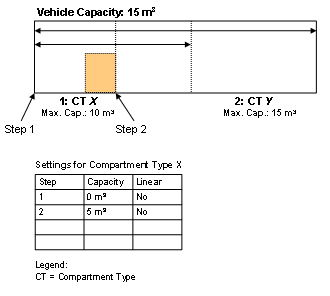
In this example, the vehicle resource comprises two compartments. Compartment 1 has compartment type X and a maximum capacity of 10m 3 . Compartment 2 has compartment type Y and a maximum capacity of 15m 3 . The total capacity of the vehicle resource is 15m 3 . Compartment 1 has two steps (0m 3 and 5m 3 ). Compartment 2 does not have any steps.
This means the following for the two compartments:
Compartment 1:
Zero consumption is possible for the compartment. That means if you leave this compartment empty, it does not consume any capacity.
Each load that is greater than 0 m 3 but less than or equal to 5m 3 results in a capacity consumption of 5m 3 . This compartment might be a refrigerated part with a door, for example. As soon as you load one frozen pizza, you have to turn on the refrigerated part. The second compartment has to start behind the door.
Each load x that is greater than 5 m 3 but less than or equal to 10m 3 results in a capacity consumption of x m 3 (due to the maximum capacity).
Compartment 2:
Each load xm 3 results in a capacity consumption of xm 3 (linear capacity consumption).
Example 2

In this example, the vehicle resource comprises two compartments. Compartment 1 has compartment type X and a maximum capacity of 10m 3 . Compartment 2 has compartment type Y and a maximum capacity of 15m 3 . The total capacity of the vehicle resource is 15m 3 . Compartment1 has four steps (0m 3 , 5m 3 , 8m 3 , and 10m 3 ). Compartment2 also has four steps (5m 3 , 7m 3 , 10m 3 , and 15m 3 ). There are two doors.
This means the following for the two compartments:
Compartment 1:
Zero consumption is possible for the compartment.
Each load that is greater than 0 m 3 but less than or equal to 5m 3 results in a capacity consumption of 5m 3 .
Each load x that is greater than 5 m 3 but less than or equal to 8 m 3 results in a capacity consumption ofxm 3 (linear capacity consumption since you have set the
Linear
indicator for this step).Each load that is greater than 8 m 3 but less than or equal to 10m 3 results in a capacity consumption of 10m 3 .
Compartment 2:
Each load x that is greater than 0 m 3 but less than or equal to 5 m 3 results in a capacity consumption ofxm 3 (linear capacity consumption since you have set the
Linear
indicator for this step).Each load that is greater than 5 m 3 but less than or equal to 7m 3 results in a capacity consumption of 7m 3 .
Each load x that is greater than 7 m 3 but less than or equal to 10 m 3 results in a capacity consumption ofxm 3 (linear capacity consumption since you have set the
Linear
indicator for this step).Each load that is greater than 10 m 3 but less than or equal to 15m 3 results in a capacity consumption of 15m 3 .