 Settlement for LSPs in an Ocean Freight Scenario
Example
You are a logistics service provider (LSP) and you have a sales organization that takes forwarding orders from your customers. You have an internal gateway organization that manages your container freight station, consolidates shipments from different sales organizations, and creates consolidated bookings with your ocean carrier. Your gateway organization creates an intercompany internal settlement document against your sales organization to recover the cost of providing the ocean booking, and any additional costs incurred at the container freight station, for example consolidation costs. Only the sales organization is in contact with your customer.
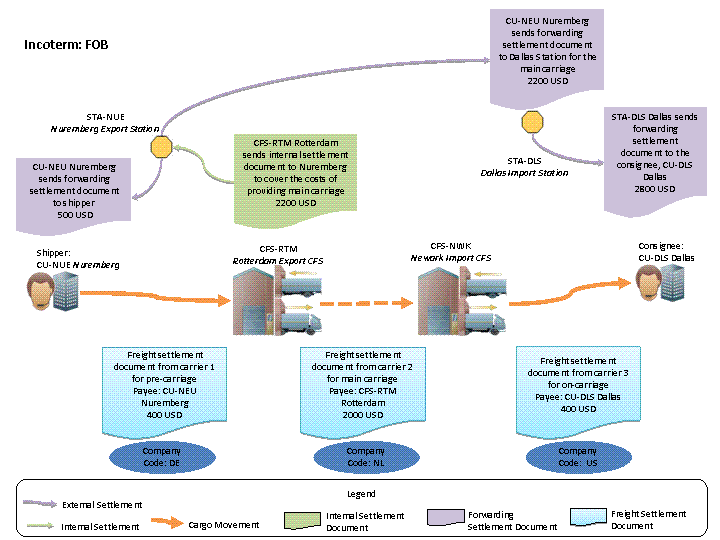
The figure below illustrates an example of a business scenario in which you use forwarding settlement documents, freight settlement documents, and internal settlement documents. It is followed by an explanation:
Term Explanation
Some of the key terms in the graphic are explained as follows:
STA
A station, which is usually the sales organization of an LSP.
Gateway
A gateway consolidation operation that includes a container freight station. The gateway is both a sales organization for internal sales and a purchasing organization for the procurement of freight services from carriers. The purchasing organization usually procures for the main carriage.
CU
A customer.
STA-NUE
The export station at Nuremberg, and also the export sales organization.
STA-DLS
The import station at Dallas, and also the import sales organization.
Incoterms
The customer in Dallas (not shown on the graphic) uses an Incoterm of FOB (Free On Board) to Rotterdam. The shipper CU-NUE Nuremberg pays for the pre-carriage. The consignee CU-DLS Dallas pays for the main carriage and the on-carriage.
In your forwarding order, you specify the shipper CU-NUE Nuremberg as the prepaid agreement party and Dallas import station STA-DLS as the collect agreement party. You specify Dallas import station STA-DLS as the collect agreement party because you use the business unit that is closest to the external customer to settle with the external customer (consignee CU-DLS Dallas). In this example, the customer in Dallas, who is the consignee CU-DLS_Dallas, pays the sales organization in Dallas (STA-DLS, Dallas import station).
Nuremberg export station STA-NUE pays the carrier for the pre-carriage and the main carriage. The Rotterdam gateway CFS-RTM settles internally with Nuremberg export station STA-NUE to recover the cost of the main carriage. The Nuremberg export station STA-NUE recovers the cost of the main carriage from Dallas import station STA-DLS. Also the Dallas import station STA-DLS settles with the consignee in Dallas (CU-DLS Dallas) for the main carriage and the on carriage.
Cargo Movement
Nuremberg export station STA-NUE picks up the cargo from the shipper CU-NUE at Nuremberg. STA-NUE moves the cargo in the pre-carriage stage to Rotterdam export container freight station CFS-RTM. The export gateway at Rotterdam is now responsible for planning and moving the cargo. It moves the cargo in the main stage to Newark import container freight station CFS-NWK. The import gateway at Newark collects the container at the port and brings it to the container freight station in Newark. Dallas import station STA-DLA then moves the cargo in the on-carriage stage to the consignee CU-DLS in Dallas. You can use export/import processing to ensure that the export organization and the import organization have the required information and business documents to transport freight across customs borders. For more information, see Export/Import Processing.
Agreements
The following agreements are in place (not shown on the graphic):
Internal agreement between Nuremberg export station STA-NUE and the export gateway at Rotterdam, to provide ocean freight services. Nuremberg export station STA-NUE is the agreement party and the export gateway at Rotterdam is the organization.
The table explains the external agreements that are in place:
Agreement Type
Agreement Parties
Reason for Agreement
Forwarding agreement
Nuremberg export station STA-NUE as the organization and Dallas import station STA-DLA Dallas as the business partner
Provide main carriage services
Forwarding agreement
Nuremberg export station STA-NUE as the organization and shipper CU-NUE Nuremberg as the business partner
Move the cargo from Nuremberg to Rotterdam as agreed in the Incoterm FOB
Forwarding agreement
Dallas import station STA-DLS as the organization and consignee CU-DLS Dallas as the business partner
Provide freight services from Rotterdam to the consignee location in Dallas
Freight agreement
Nuremberg export station STA-NUE as the organization and Carrier 1 as the business partner
Provide pre-carriage services
Freight agreement
Rotterdam export gateway as the organization and the ocean carrier as the business partner
Provide ocean freight services
Freight agreement
Dallas import station STA-DLS as the organization and Carrier 3 as the business partner
Provide on-carriage services
Forwarding Settlements
The forwarding settlement document is a business document that contains the freight costs, and is a request to settle those costs. SAP TM sends the forwarding settlement document to SAP ERP to create a billing document to be sent to the customer.
Nuremberg export station STA-NEU sends a forwarding settlement document to the shipper CU-NEU Nuremberg for USD 500. The shipper pays for the pre-carriage cost.
Dallas import station STA-DLS sends a forwarding settlement document to the consignee CU-DLS Dallas for USD 2800. The consignee pays for the main carriage and on-carriage costs.
Nuremberg export station STA-NEU also sends a forwarding settlement document to the internal organization Dallas import station STA-DLS for USD 2200. The Dallas import station pays for the main-carriage cost.
Freight Settlements
Carrier 1 invoices Nuremberg export station STA-NEU for USD 400, the cost of providing the pre-carriage transportation service. In SAP TM, STA-NEU creates a freight settlement document for the pre-carriage. It sends the freight settlement document to SAP ERP, where it verifies the invoice it receives from Carrier 1 against the details in the freight settlement document. If the details match, it pays Carrier 1 from SAP ERP.
Rotterdam export gateway CFS-RTM and Dallas import station STA-DLS Dallas follow the same process. They pay carriers 2 and 3 USD 2000 and USD 400 respectively.
Internal Settlements
Rotterdam export gateway CFS-RTM creates an internal settlement on Nuremberg export station STA-NEU to recover the costs it incurred in providing the transportation services for the main carriage. CFS-RTM receives an invoice from its carrier for USD 2000, but it can also charge STA-NEU USD 2200 based on the internal rates between the organizations. As a result CFS-RTM can make USD 200 profit from the transportation.
Your company can also base the internal settlement document on the actual costs from the carrier. In this case CFS-RTM does not make a profit and bills STA-NEU for USD 2000.
Consolidated Shipment
The graphic illustrates a single shipment scenario. You can also manage a consolidated shipment scenario where Rotterdam export gateway CFS-RTM consolidates multiple forwarding orders (movements of cargo for an external customer) from different organizations in your company. CFS-RTM moves the cargo for the forwarding orders to Newark import container freight station CFS-NWK. CFS-NWK deconsolidates the cargo. The individual import freight stations then deliver the cargo to the different consignees.
Rotterdam export gateway CFS-RTM sends an internal settlement document for the main-carriage cost to each of the internal export organizations for the forwarding orders. It can base the settlements on the internal rates agreed between the organizations or the cost of executing the transportation services.
Settlement Based on Agreed Rates
Rotterdam export gateway CFS-RTM can use a standard agreed rate as a basis for its freight costs. It can use the agreed rate to settle the cost it incurs in servicing each forwarding order that it consolidates and ships. For more information, see Standard Charge Calculation.
Settlement Based on Freight Costs
If CFS-RTM bases the settlements on the costs, it must determine the share of the overall execution cost for which each organization is liable. CFS-RTM uses cost distribution to share the costs to the organizations. Using cost distribution, CFS-RTM can determine the share of the overall freight booking cost that applies to each of the forwarding orders, by distributing the freight booking cost at the forwarding order level. It can then use the distributed costs for each of the forwarding orders to create the settlement.
For more information about distributing freight costs to charge type level, see Cost Distribution Management. For more information about transferring distributed costs from the freight side to the forwarding side, and using the costs as a basis for settling with a customer or an internal organization, see Cost Pull.
More Information
Subject | More Information |
|---|---|
Overview of how the forwarding settlement process works | |
Overview of how the freight settlement process works | |
Overview of internal settlement management |